
Female Headshots: What Women Actually Navigate That Men Don't
Female headshots involve a narrower band of acceptable choices and a documented competence-warmth tradeoff men don't face. Here's how to make strategic decisions.


I used to think the main difference between female and male headshots was styling. More makeup, softer lighting, maybe a smile. That's what conventional wisdom suggests.
Then I started digging into the research. And I found something structural that changes how I think about this entirely.
Women face a documented "competence vs. warmth" double bind that men largely don't encounter. Display too much warmth, and perceived competence drops. Project too much authority, and warmth ratings tank. Men can be perceived as highly competent without needing to prove their warmth at all.
This isn't about styling tips. It's about understanding that female headshots require more intentional calibration across expression, attire, and lighting because the acceptable range is narrower. I've written about headshot poses for women before, but this goes deeper.
Here's what I learned about navigating these constraints strategically.
The Competence-Warmth Tradeoff: Why the Stakes Are Higher
The foundational difference isn't cosmetic. It's psychological.
Researchers call it the Stereotype Content Model. Humans judge others on two primary dimensions: warmth (are your intentions good?) and competence (can you execute on them?). This applies to everyone. But the consequences differ by gender.
Women are stereotypically expected to be communal and warm. When women display highly agentic, competent traits, they frequently face what researchers call a "warmth penalty". They're perceived as competent but cold. Men, conversely, can project competence without needing to simultaneously prove their warmth.
This creates a narrower band of acceptability. A male executive can look serious in his headshot and signal authority. A female executive with the same expression risks being perceived as cold or unlikable.
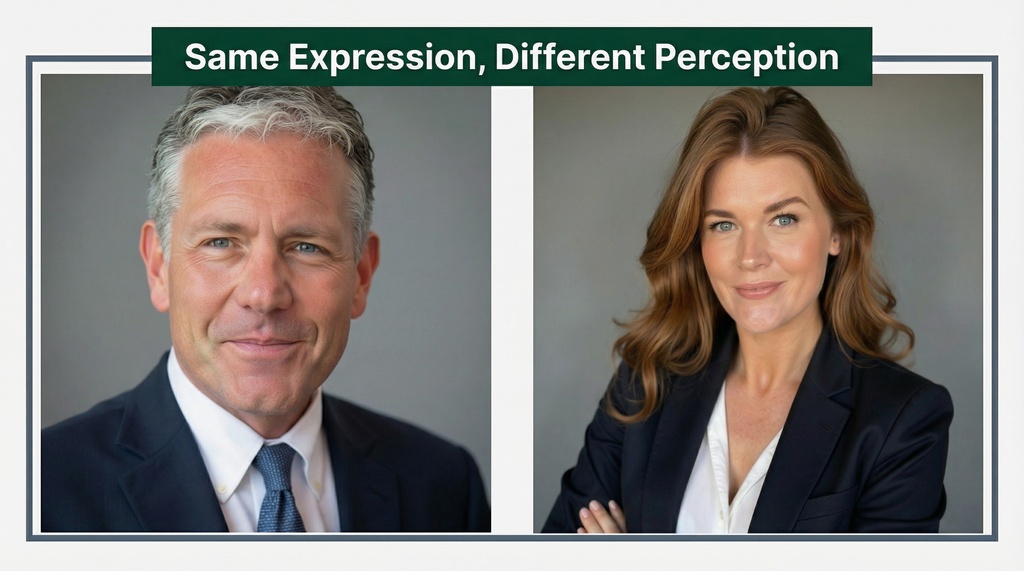
There's also an age component. Photofeeler data analyzing over a million ratings found that men over 35 are perceived as the most competent demographic. Women's perceived likability, meanwhile, declines rapidly with age. And here's the structural issue: women's perceived competence is much more closely tied to their likability than it is for men. If raters don't "like" a woman's photo, they're more likely to question her intelligence.
This is a systems issue. Understanding it helps women stop second-guessing arbitrary advice and start making informed decisions.
Expression Engineering: The Science Behind the Smile
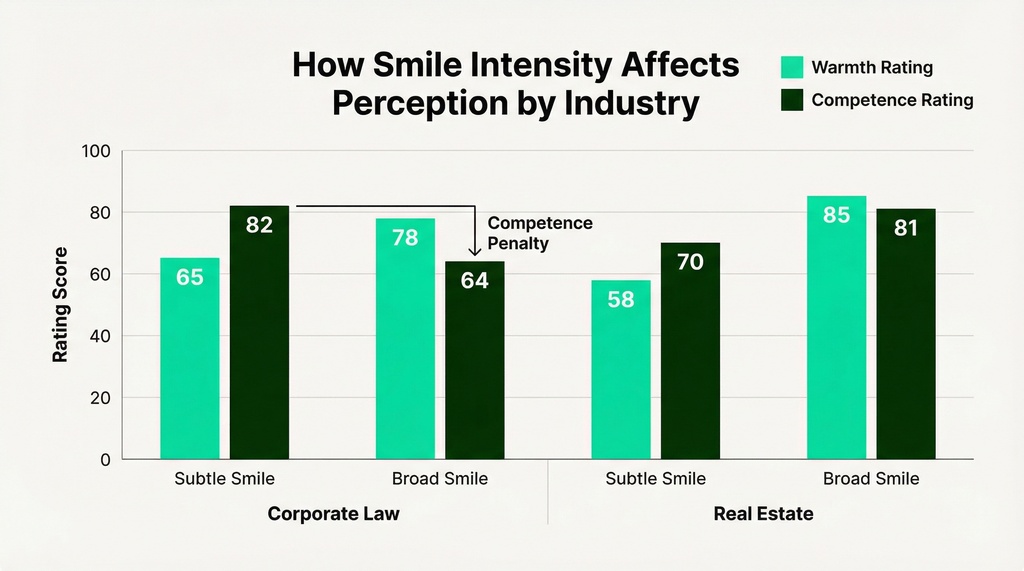
The advice to "just smile" is well-intentioned but incomplete. Smile intensity directly impacts the competence-warmth tradeoff, and the effect varies by industry.
A 2023 study found that displaying a broad smile (compared to a slight smile) makes subjects appear warmer but less competent. This competence penalty is highly context-dependent.
In utilitarian fields like corporate law or finance, a broad smile triggers what researchers call a compensation effect. Viewers subconsciously lower competence ratings. In hedonic or service industries like hospitality or real estate, a broad smile actually boosts both warmth and competence.
So the strategic question isn't "should I smile?" It's "what does my industry reward?"
Not all smiles are equal either. Meta-analyses show that Duchenne smiles, which include activation of the cheek raiser muscle creating crow's feet around the eyes, are rated as significantly more authentic and trustworthy than forced smiles.
One technique I've seen recommended is "squinching": a slight narrowing of the eyes that signals relaxation and confidence. Wide-open eyes, by contrast, can signal nervousness. Combining a Duchenne smile with a subtle squinch gives you warmth without sacrificing authority.
Lighting and Posing: The Technical Differences
Photographers historically use different technical setups for men and women. This isn't arbitrary. It's driven by societal "standards of beauty" that have calcified into industry practice.
For male subjects, photographers typically use hard, directional light. This produces shadows, angular shapes, and emphasizes texture. Jawlines, wrinkles, facial hair. These are read as strength.
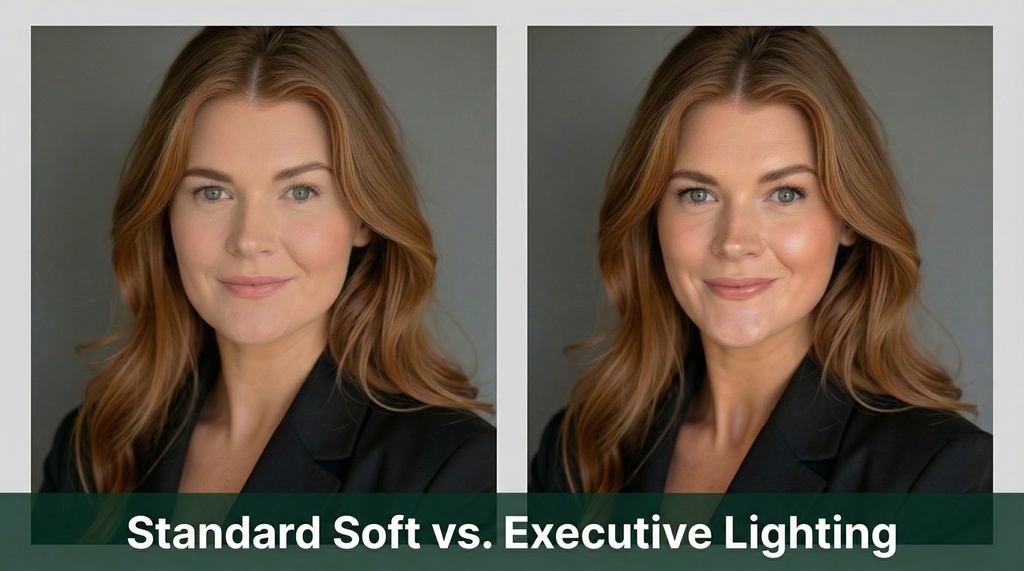
For women, the standard is soft, diffused lighting using large softboxes or fill light. This minimizes shadows and skin texture, creating a softer, more youthful complexion.
Here's the strategic takeaway: overly soft lighting can diminish facial structure and authority. Women seeking executive presence should request a subtle "kicker" or edge light to define the jawline while maintaining overall soft illumination. This retains the flattering quality while adding definition.
Body language in photos translates to geometric shapes. Triangles and vertical lines convey strength. Horizontal lines are calming. A common concern I hear from women is that taking up space looks "too masculine" while seated poses risk appearing subservient.
One effective approach is crossed arms (creating a strong triangle) softened by a confident smile. This creates openness without sacrificing authority. The geometry signals strength. The smile signals approachability. You're working both dimensions simultaneously.
Industry-Specific Calibration: One Size Does Not Fit All
The definition of "professional" varies drastically by sector. What works in creative media would be wrong for corporate law. What signals competence in finance might read as rigid in tech.
Here's how the research breaks down across industries:
| Industry | Expression | Attire | Key Nuance |
|---|---|---|---|
| Corporate Law | Neutral to soft, closed-mouth smile | Dark structured blazer, high-collar blouse | Broad smiles risk competence penalty |
| Finance | Confident, subtle smile | Tailored suit or structured jacket | High penalty for casual wear |
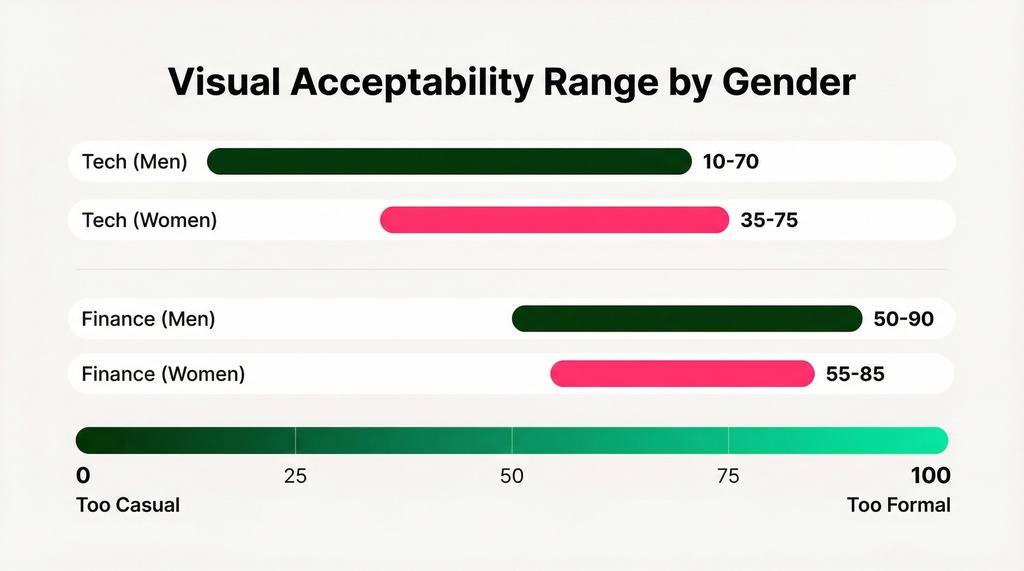
| Tech & Startups | Friendly, approachable smile | Smart-casual: fitted sweaters, blazers over blouses | Women penalized for looking "too casual" unlike male peers |
| Healthcare | Gentle, compassionate smile | White coat over soft blues/greens | Must project calm and empathy |
| Real Estate | Wide, genuine, toothy smile | Polished blazer, colorful confident outfits | Broad smiles increase both likability and competence here |
| Creative & Media | Open smile or mid-laugh, highly expressive | Bold jewel tones, interesting textures | Avoid neon or tight patterns that cause distortion |
Notice the pattern. Tech and startups present an interesting case. Men often wear t-shirts or hoodies. But women are penalized for looking too casual and should opt for "elevated casual" instead. Same industry, different rules.
This is why generic headshot advice fails women. The constraints aren't universal. They're context-dependent.
AI Headshots: Democratization With Caveats
The emergence of AI headshot generators has drastically reduced the cost of professional photos. Traditional sessions run $150 to $500. AI services like InstaHeadshots offer packages starting around $49 to $69 for dozens of options.
For most professionals, this is a significant unlock. You get variety, speed, and accessibility that traditional photography can't match.
But there are specific risks women should understand.
Audits of generative models reveal severe gender biases. Models consistently generate men for prompts like "CEO" or "doctor" while overrepresenting women as "nurses." Furthermore, AI models tend to portray women as younger and more likely to smile than male counterparts, underrepresenting older professional women.
Women of color face additional issues. Reports indicate AI tools frequently lighten skin tones and alter natural hair textures to align with Eurocentric beauty standards. One user described the effect as "just made me look like a white person."
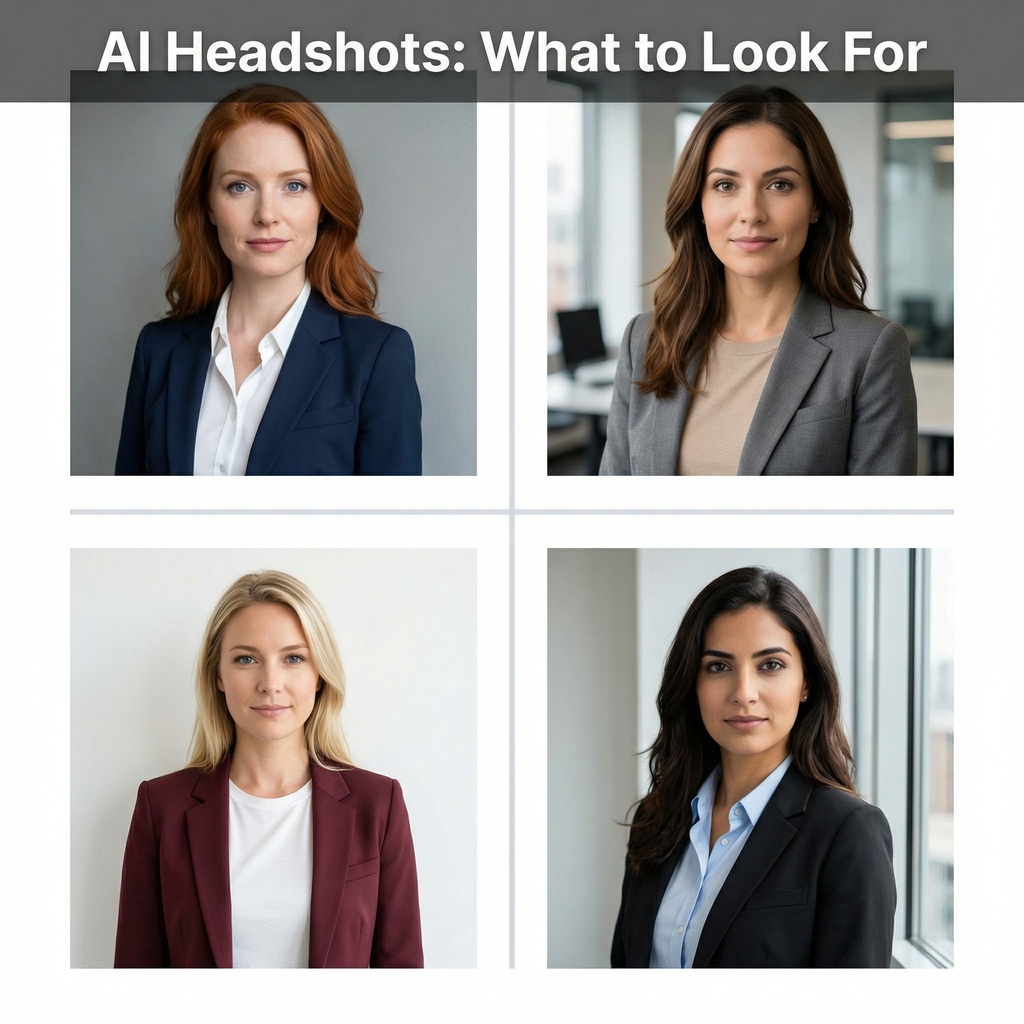
The solution isn't to avoid AI entirely. It's to review outputs carefully, request corrections when skin tones or features look altered, and ensure the final image actually looks like you. The 2026 trend in professional photography is moving away from heavily airbrushed, "plastic" skin toward natural retouching that leaves natural texture and age lines intact.
Don't scale what you haven't stabilized. If AI outputs consistently misrepresent you, a traditional session may be worth the investment.
Practical Actions: What to Do With This Information
Understanding these dynamics is only useful if it translates to action. Here's what I recommend:
Test before committing. Use platforms like Photofeeler to A/B test different expressions. Compare a Duchenne smile against a subtle smile with a squinch. See which yields the highest combined competence and likability scores for your specific face and industry.
Advocate for your lighting. Explicitly ask your photographer for a setup that flatters but retains authority. Request soft key light combined with subtle edge lighting to define the jawline. Avoid overly-flattened "glamour" lighting that strips away executive presence.
Calibrate to your industry. Review the table above. If you're in finance, a broad smile may hurt you. If you're in real estate, it helps. Don't guess. Match your expression to what your industry rewards.
Consider navy blue. It's universally cited as the best color for professional headshots across industries, receiving the highest trust ratings. Charcoal gray is a close second.
Update regularly. Career experts recommend updating headshots every one to two years, or immediately following a significant appearance change or career pivot. Outdated photos create trust issues during video interviews.

The Real Difference Is Strategic, Not Cosmetic
Female headshots aren't just about adding makeup and softer lighting. They're about navigating a narrower band of acceptability with more variables to control.
The competence-warmth tradeoff is real. Industry expectations vary. And the advice "just smile" ignores that smile intensity has documented effects on perceived competence that differ by context.
Constraints create clarity. Once you understand the structural differences, you can make intentional choices rather than defaulting to outdated conventions. Choose your expression based on what your industry rewards. Request lighting that projects authority without losing warmth. Test your options with real data.
This isn't about conforming to unfair standards. It's about understanding the game so you can play it on your terms.
Most growth problems are structural. The same is true for professional image problems. Fix the system understanding first. The tactics follow.