
Headshot Poses That Actually Work: Industry-Specific Positioning for 2026
Master the exact shoulder angles, torso positions, and arm placements that signal authority or approachability based on your industry and seniority level.

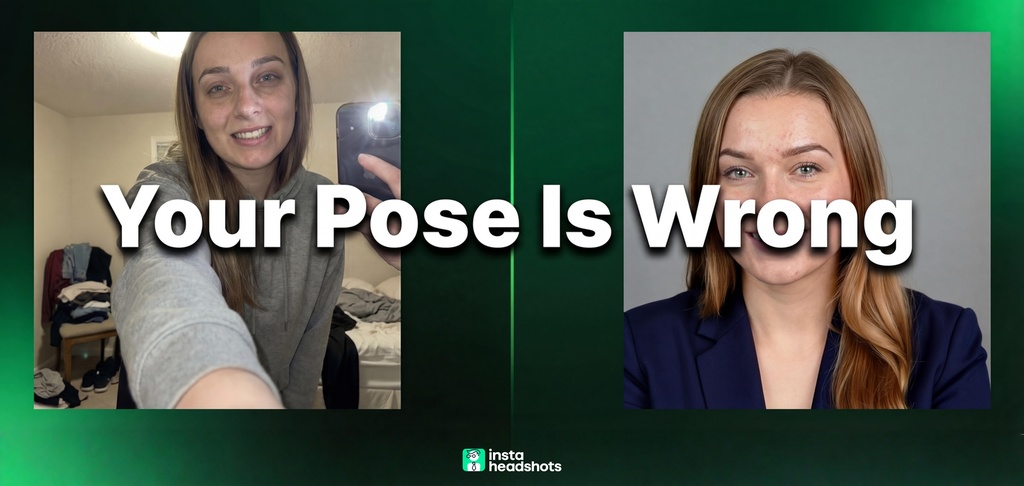
I've spent years watching professionals invest in headshots that look technically perfect but communicate the wrong message entirely. Great lighting. Sharp focus. And a pose that makes a marketing director look like a courtroom attorney.
Here's what most people miss: your pose isn't decoration. It's communication. The angle of your shoulders, the tilt of your torso, where your arms end up in the frame: these choices signal specific qualities to whoever views your profile. Get it right for your context, and you project exactly what your industry and role demand. Get it wrong, and you create what I call visual friction. People sense something is off, even if they can't name it.
Most pose guides give you generic advice. Angle 45 degrees. Relax your shoulders. As if one formula works for everyone from startup founders to law partners. It doesn't. After digging through research on professional perception and working with headshot positioning across industries, I've found the signal is far more specific. And yes, there are still meaningful differences in how poses read based on gender presentation, but it's about physics and visual perception, not outdated stereotypes.
Let me break down exactly what works, why it works, and how to apply it to your specific situation. I've covered the foundational psychology behind poses before, but here I'm going deeper into the tactical choices that separate a generic headshot from a strategic one.
The Three-Quarter Turn: Your Universal Starting Point
Before we get into industry-specific modifications, you need to understand the baseline that works for almost everyone.
The instinct for most people is to face the camera straight on. This is a mistake. Facing directly forward flattens the image into a two-dimensional plane and makes shoulders look wider than they are. The result? You look like a mugshot.
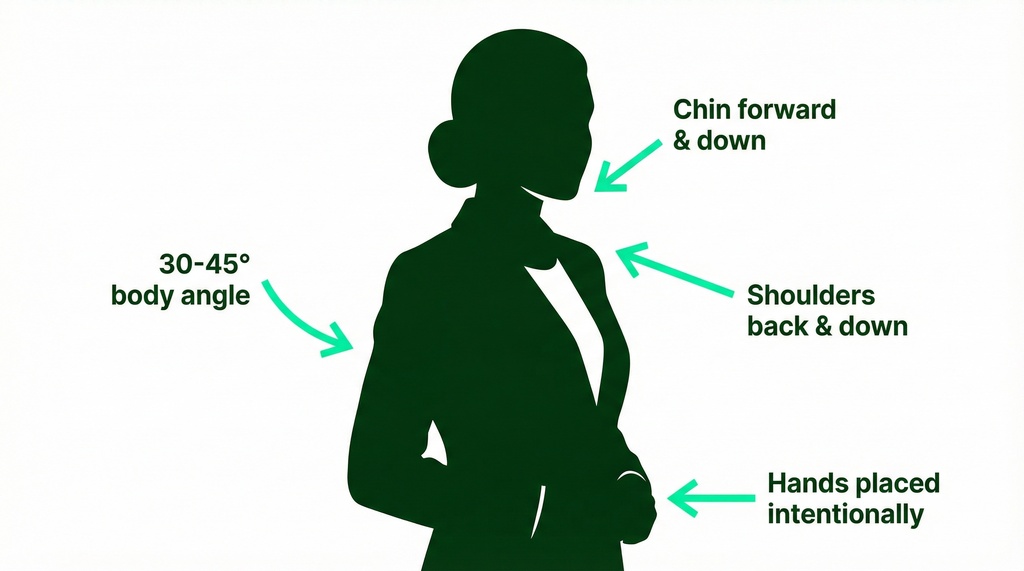
The fix is simple: turn your body 30 to 45 degrees away from the camera, then rotate your head back toward the lens. This creates depth and visual interest. It narrows the shoulder line naturally. And it gives the image a sense of movement rather than rigidity.
From this base position, a small forward lean (about an inch) signals engagement. Leaning back reads as disinterested or guarded. The difference is subtle, but viewers perceive it instantly.
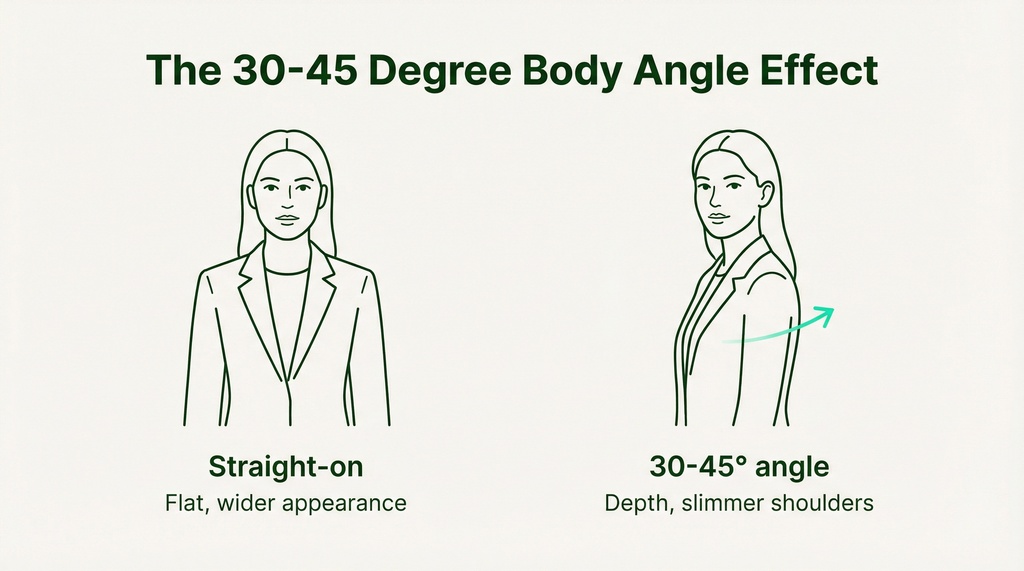
Think of this as your default setting. From here, you'll make specific adjustments based on what you need to communicate.
The Micro-Adjustments That Separate Amateur From Professional
Once you've got the angle right, two small facial adjustments make a significant difference.
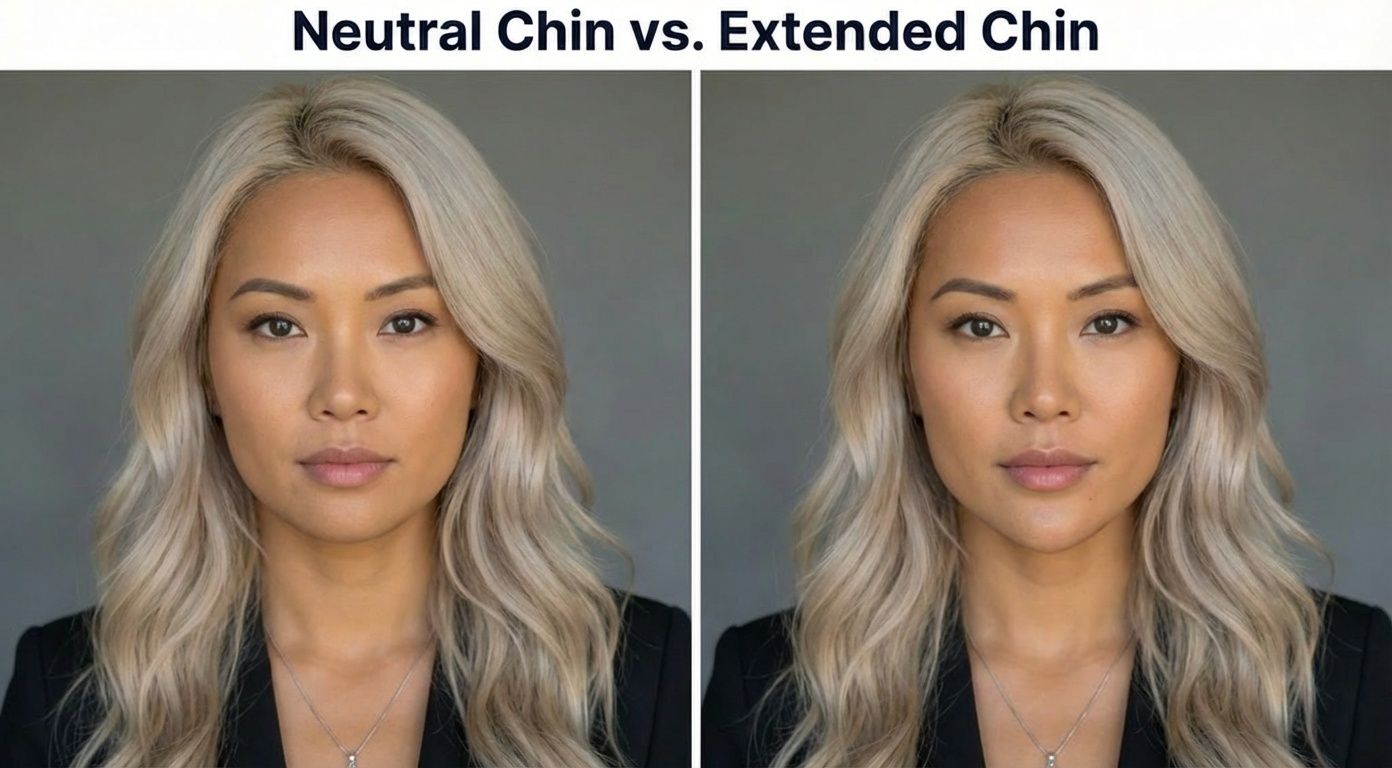
The chin extension. Portrait photographer Sue Bryce calls this the "turtle" technique. When your chin rests in its natural position, gravity softens the jawline. On camera, this reads as heaviness. The fix: push your chin forward toward the camera (about an inch) and tilt it slightly down. This sharpens your jawline and creates separation between your face and neck.
The common mistake? Tilting the chin up instead. This projects condescension and highlights your nostrils. Not the look you're going for.
The squinch. Photographer Peter Hurley popularized this term for a specific eye adjustment. It means narrowing your lower eyelids slightly, as if you're about to smile with just your eyes. This replaces the wide-eyed "deer in headlights" look with confident, engaged eye contact.
These aren't dramatic changes. They're micro-adjustments that most viewers can't consciously identify. But the cumulative effect is the difference between "that person looks competent" and "something seems off."
Industry-Specific Positioning: Why Context Determines the "Right" Pose
Here's where most generic advice fails. The same pose that projects authority for a law partner can make a real estate agent look cold and unapproachable. Constraints create clarity, and your industry's visual expectations are a constraint worth understanding.
Finance and Law: Authority First
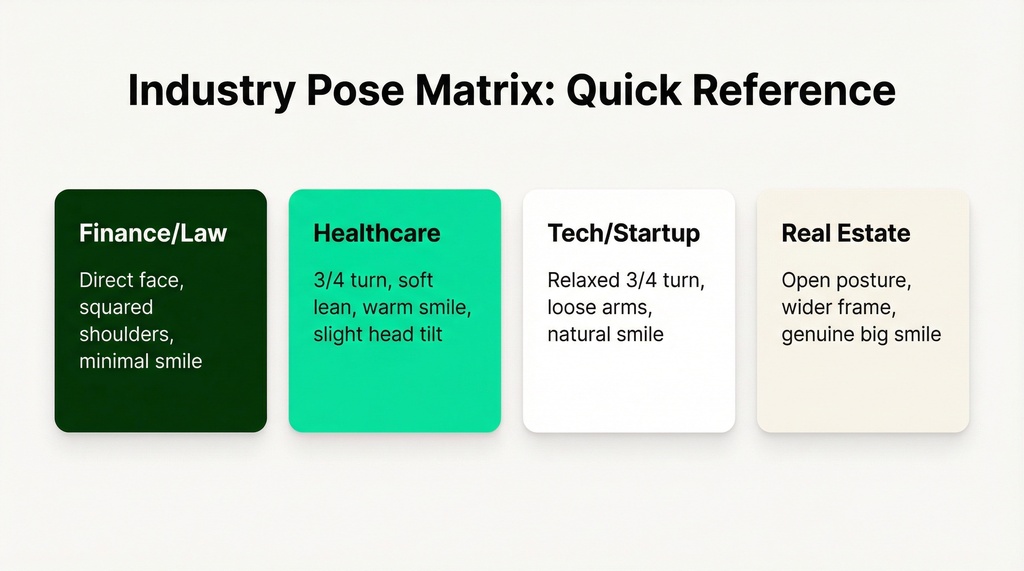
These industries favor a direct face or only a slight three-quarter turn with squared shoulders. The expression should be confident: a minimal smile or a squinch, but not a grin. The message is competence, stability, and seriousness.
What to avoid: casual posing, big smiles, or loosely crossed arms. These read as too relaxed for contexts where clients are entrusting you with their money or legal fate.
Healthcare: Reassuring Approachability
Medical professionals benefit from a more pronounced three-quarter turn, a soft forward lean, and a warm, genuine smile. A slight head tilt (5 to 10 degrees) toward the higher shoulder signals friendliness.
The goal here is trust and accessibility. Patients want to feel they can talk to you. Stiff formality or an intimidating direct stare works against that.
Tech and Startups: Relaxed Agility
Founders and tech workers lean into relaxed three-quarter turns, loosely crossed arms, or one hand in a pocket. The energy is smart and approachable. You're explicitly avoiding over-formal corporate stiffness.
This doesn't mean sloppy. It means intentionally casual in a way that signals "I solve problems" rather than "I follow procedures."
Real Estate: Client-Facing Warmth
Real estate agents require high trustworthiness. This comes through open postures, slightly wider framing (more of the upper body visible), and big, genuine smiles. People are about to trust you with the biggest purchase of their lives. Your headshot needs to say "I'm on your side."
Gender Presentation: Physics, Not Stereotypes
Let me be direct about this. The old rules about "men should pose this way, women should pose that way" are mostly garbage. But that doesn't mean all posing is identical regardless of body structure.
Modern headshot positioning focuses on bone structure, shoulder width, and neck length rather than rigid gender formulas. Photographer Ben Marcum puts it clearly: "It's geometry, not gender."
That said, social perception still plays a role in how postures are received. Research on physician body postures found that open postures affect competency perception differently for men versus women. Male physicians in open postures were perceived as more professionally competent across all roles. Female physicians in open postures were also seen as highly competent, but were rated more positively on social competencies when assuming more closed postures.
What does this mean practically? Women in male-dominated industries sometimes face pressure to adopt traditionally "strong" or neutral poses to avoid being perceived as less capable. The solution isn't to ignore these dynamics. It's to make conscious, strategic choices about what you want to communicate.

The Arm and Hand Playbook
For standard head-and-shoulders framing, hands shouldn't be visible. But for waist-up shots, hand placement becomes a critical communication tool.
Hands hanging lifelessly at your sides look awkward. Hands jammed into pockets can look too casual for strict corporate contexts. The key is intentionality.
Crossed arms: This gets a bad reputation, but it can work. The key is keeping arms loose and relaxed, with forearms resting on each other rather than hands gripping biceps. Tight crossed arms read as defensive. As photographer John Armato notes, "it's often seen as a power move, but it's actually defensive." Loose crossed arms, however, can project casual confidence, especially in tech or creative contexts.
One hand in pocket: Place one hand in your pocket with the thumb hooked on the edge. This conveys natural ease without looking sloppy.
Clasped hands in front: This can create a V-down body profile that makes you look slimmer, though it sometimes reads as nervous if held too tightly.
Most growth problems are structural. The same applies to pose problems. If something feels awkward, it's usually because the underlying position isn't right, and no amount of hand adjustment will fix it.
The Seniority Ladder: How Positioning Shifts With Career Level
As professionals move from entry-level to the C-suite, their visual signaling must shift from pure approachability to stability and authority.
Early career: Lower-seniority subjects should avoid overly dominant, squared-off stares. What reads as "confident" on a CEO can tip into "intimidating" or "unearned arrogance" on someone junior. Stick with the three-quarter turn, genuine smile, and approachable energy.
Mid-career: You can start introducing more squared shoulders and slightly more serious expressions. The balance shifts toward competence over pure friendliness.
Executive level: For late-career professionals and executives, the primary goal is projecting earned confidence. Executives often utilize a straight-on or minimally angled stance with squared shoulders. This is why so many C-suite pages feature similar positioning: it signals stability and command.

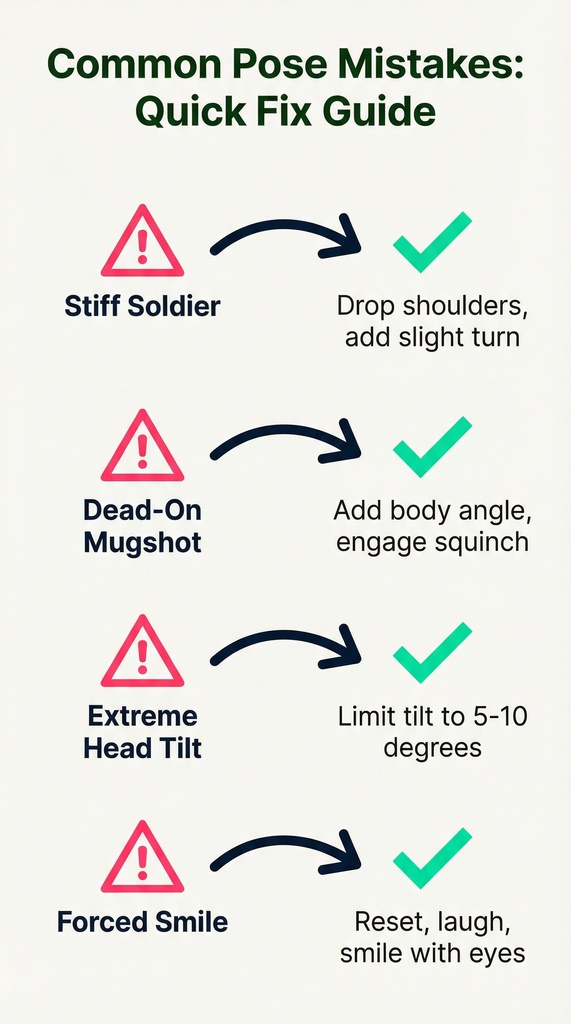
Common Mistakes and How to Fix Them Fast
Even with the right angle, micro-errors can undermine your headshot. Here are the patterns I see most often:
The stiff soldier. Arms pinned to sides, shoulders hiked up to ears. The fix: consciously pull shoulders down and back before every shot. Introduce a slight body turn or drop one shoulder slightly lower than the other.
The dead-on mugshot. Squared shoulders with wide eyes and zero expression. The fix: add a body angle and engage the squinch to humanize your face.
The extreme head tilt. Tilting 15 degrees or more signals a "confused puppy" look. Restrict tilts to a barely noticeable 5 to 10 degrees.
The forced smile. A mouth smiling while the eyes remain flat looks disingenuous. The fix: reset between takes, laugh genuinely, and ensure the smile reaches your eyes.
Putting It Together: Your Pre-Session Checklist
Before your next headshot session (whether with a photographer or using an AI service like InstaHeadshots), run through this checklist:
Know your industry baseline. What do the top performers in your field look like in their headshots? Study their positioning.
Determine your seniority signal. Are you projecting approachability (early career) or authority (executive)?
Set your angle. Start with the three-quarter turn as default. Modify based on industry (more squared for finance/law, more angled for creative/healthcare).
Check your chin. Forward and slightly down. Not up.
Decide on hands. If they're in frame, place them intentionally. Loose crossed arms, one hand in pocket, or clasped in front.
Practice the squinch. Narrow those lower eyelids slightly. Confident, not wide-eyed.
The data is clear: profiles with professional photos receive 21 times more views and 9 times more connection requests than those without. Viewers judge you in 100 milliseconds. In that fraction of a second, your pose is communicating something. Make sure it's the right message for your context.
Execution is a strategy. The difference between a generic headshot and a strategic one isn't luck or natural photogenic qualities. It's understanding the mechanics, knowing your context, and making intentional choices. Now you have the framework to do exactly that.