
Female Headshots: The Technical Differences That Actually Matter
Female headshots require different lighting, poses, and expressions than male headshots. Here's what I learned about optimizing for feminine features and professional perception.

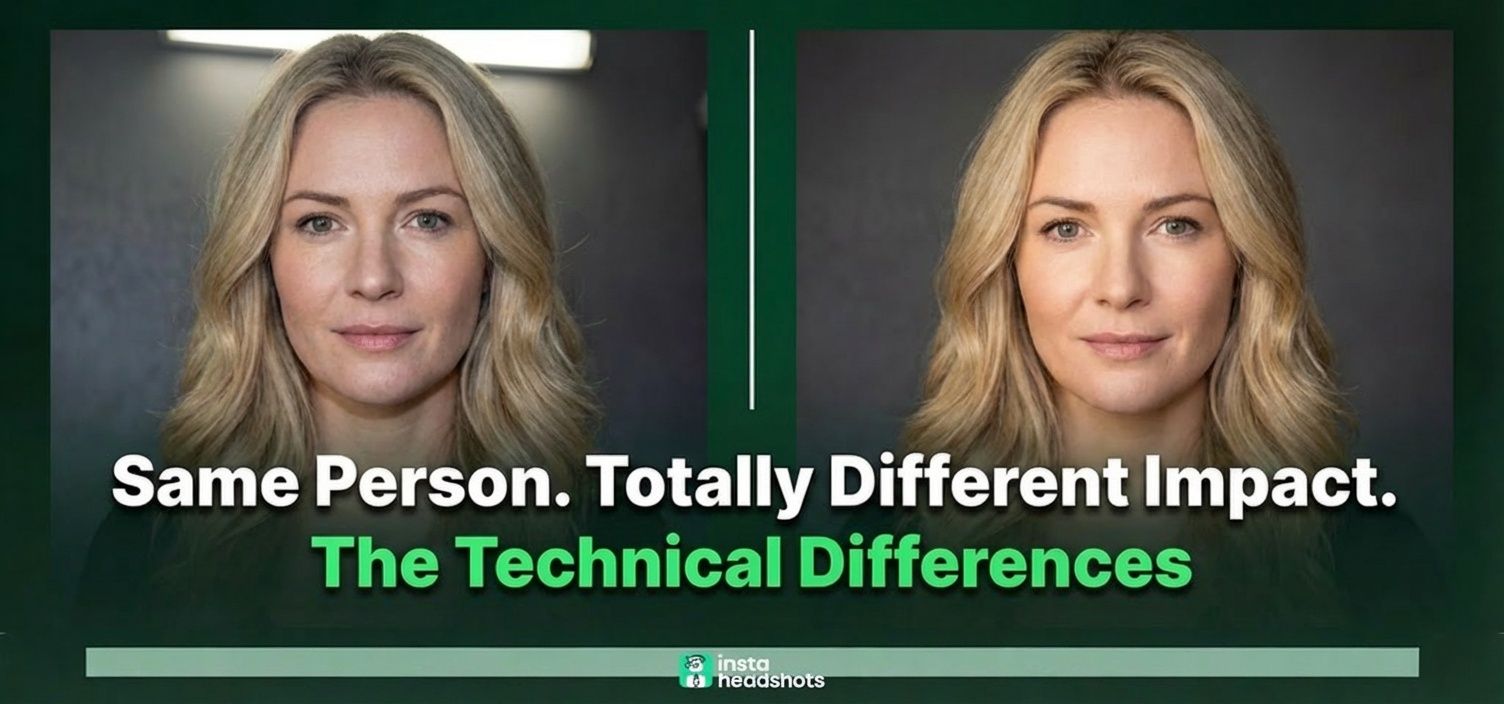
I used to think headshot advice was universal. Same lighting. Same poses. Just swap the wardrobe and add makeup for women. Then I started digging into the actual data. What I found changed how I think about professional photography entirely.
The differences between male and female headshots go far deeper than cosmetics. Lighting that makes a man look authoritative can wash out feminine features or create harsh shadows. Poses that signal confidence in men can trigger negative perception biases in women. Even the "neutral expression sweet spot" differs by gender. This isn't about reinforcing stereotypes. It's about optimizing for different starting conditions, the same way you'd adjust any system for different inputs.
Whether you're booking a photographer or using AI headshot tools, understanding these technical differences helps you make better decisions. Here's what I learned.
The Quick Answer: What Makes Female Headshots Different
If you're short on time, here's the summary. Female headshots require distinct approaches across five areas:
Lighting: Butterfly and Loop patterns work better than dramatic Rembrandt or Split lighting. Feminine features need softer contrast.
Focal length: Longer lenses (85mm+) compress facial proportions more flatteringly. Short lenses distort features in ways that are more noticeable on softer bone structures.
Posing: The same "power pose" that reads as confident on a man can read as aggressive on a woman. Small geometric adjustments solve this.
Expression: Women face a documented warmth-competence trade-off. The right smile plus a subtle "squinch" balances both.
Wardrobe: Color matching to skin tone matters more because women have more wardrobe variables. Solid colors in navy or jewel tones work best.
Now let me break down the physics and psychology behind each.
Lighting: Why the Same Setup Fails Different Faces
Lighting isn't gender-neutral. The interaction between directional light and bone structure changes everything about how a face is perceived.
For female headshots, two lighting patterns consistently outperform others:
Butterfly lighting positions the key light directly in front and above the subject. It creates a symmetrical shadow under the nose and accentuates cheekbones while minimizing skin imperfections. Research shows it conveys elegance and high trustworthiness.
Loop lighting places the key light at 45 degrees, slightly above eye level. It creates a small crescent shadow on one side of the nose. This pattern is highly versatile and conveys warmth and approachability.
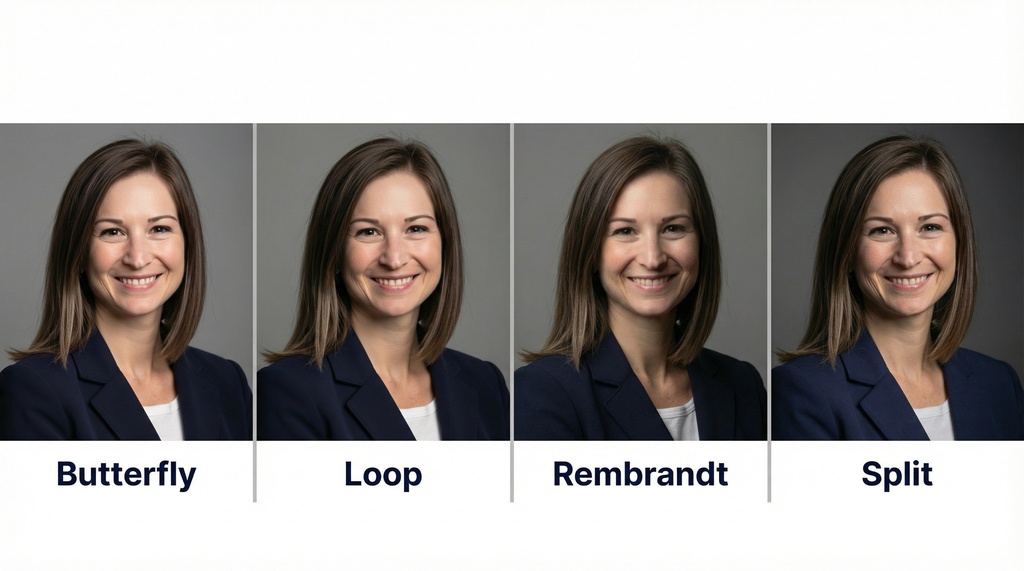
Contrast that with patterns often used for masculine faces:
Rembrandt lighting creates a distinctive triangle of light on the cheek opposite the key light. It emphasizes strong jawlines but can be unflattering for round or softer features.
Split lighting divides the face into stark halves of light and shadow. While it conveys strength, studies show it significantly decreases perceived trustworthiness.
Here's the structural issue: masculine bone structure typically features stronger brow ridges, sharper jaw angles, and more pronounced cheekbones. Dramatic directional lighting accentuates these features. Feminine bone structure is often softer and more rounded. The same dramatic lighting creates unflattering shadows or washes out depth entirely.
| Lighting Pattern | Best For | Perception Effect |
|---|---|---|
| Butterfly | Feminine features, elegance | High trust, high appeal |
| Loop | Most face types, warmth | Approachable, professional |
| Rembrandt | Strong bone structure | Dramatic, intense |
| Split | Bold statements | Low trust, edgy |
Takeaway: When booking a session, explicitly request Butterfly or Loop lighting. If using AI tools, look for options that simulate soft, frontal lighting rather than dramatic side-lighting.
Focal Length: The Hidden Distortion Factor
This one surprised me. The camera lens itself changes how your face looks in ways that favor different features.
Short focal lengths (around 50mm) make faces appear rounder with broader noses and wider-set eyes. Longer focal lengths (85-105mm) compress the face, making it appear flatter and more proportional. Research confirms that longer focal lengths produce more attractive portraits.
Why does this matter more for women? Feminine features tend to be more delicate and proportional. Wide-angle distortion exaggerates asymmetries and makes features appear bulbous. The compression from longer lenses is more forgiving.
Most professional headshot photographers know this. But if you're working with someone less experienced or doing a DIY setup, this is critical. Stand farther back and zoom in rather than getting close with a wide lens.
The Warmth-Competence Trap: Expression Psychology
This is where it gets interesting. And frustrating.
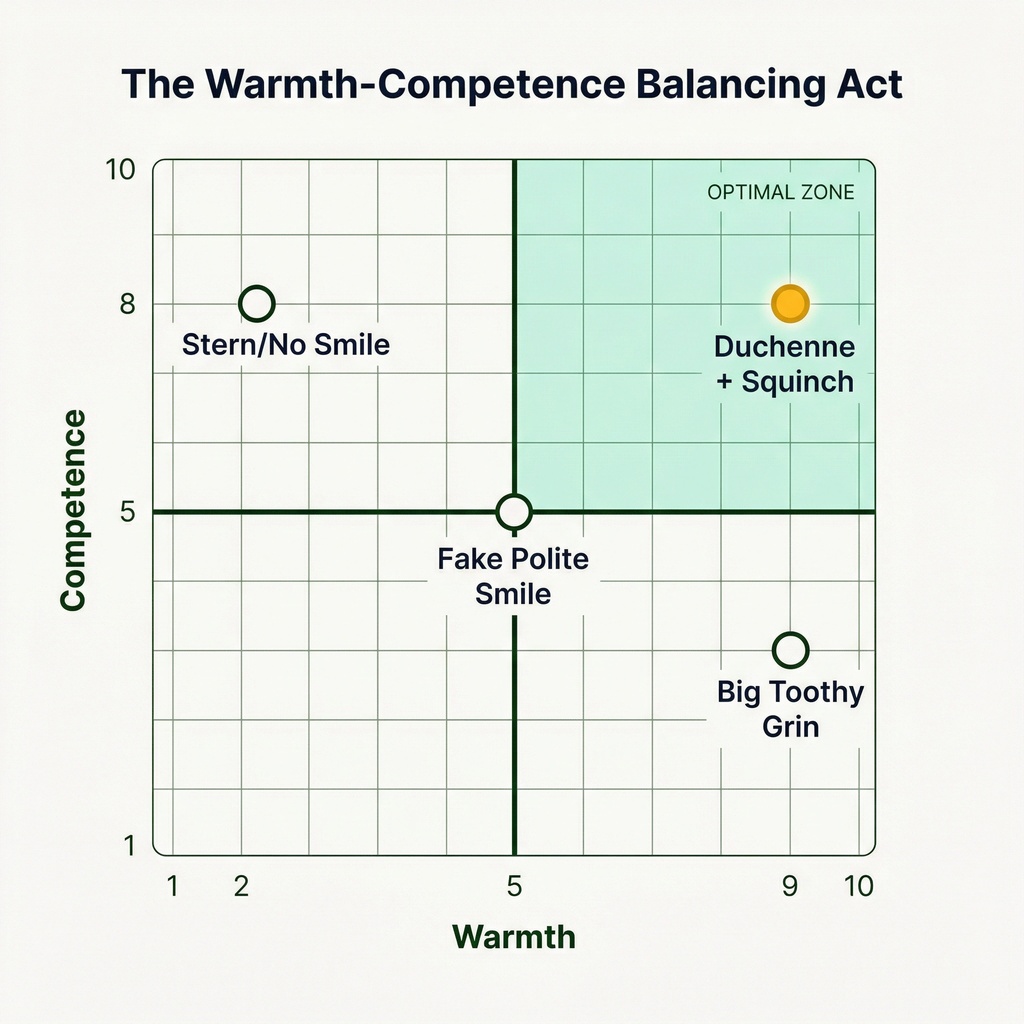
Women face a documented perception penalty in professional contexts. Research on social cognition shows that highly competent women are often penalized with lower warmth ratings. Men don't face this trade-off at the same intensity. A man can project pure competence without being labeled "cold." A woman projecting the same competence risks being labeled "bossy" or "difficult."
This creates a headshot optimization problem. How do you signal competence without sacrificing warmth?
The answer involves two techniques working together:
The genuine smile: Duchenne smiles (the real ones that crinkle the eyes) are universally rated as more trustworthy. Fake smiles don't engage the muscles around the eyes and register as insincere. For women especially, a genuine smile with teeth visible increases likability without undermining competence.
The squinch: Photographer Peter Hurley popularized this technique. Slightly narrowing the eyes projects confidence and focus. Wide eyes signal fear or uncertainty. The squinch plus genuine smile creates the optimal balance.
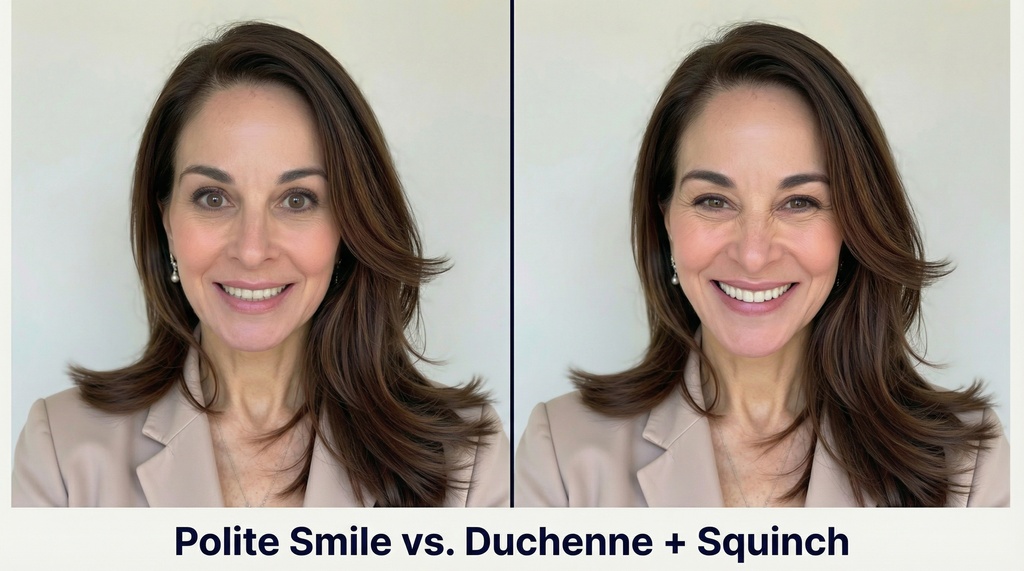
Here's the constraint: women are socially expected to smile more than men in professional contexts. Not smiling can read as cold or unfriendly. But over-smiling can undermine perceived authority. The Duchenne-squinch combination threads this needle.
Pose Geometry: Small Angles, Big Perception Shifts
Posing involves geometry, bone structure, and the specific traits you want to convey. But the same geometric adjustments produce different perceptions based on gender.
Expansive "power poses" generally increase perceived competence for everyone. The catch: women face additional sociological constraints. A stance that reads as "confident leader" on a man can trigger the warmth penalty on a woman.
The solution is precise geometric adjustment:
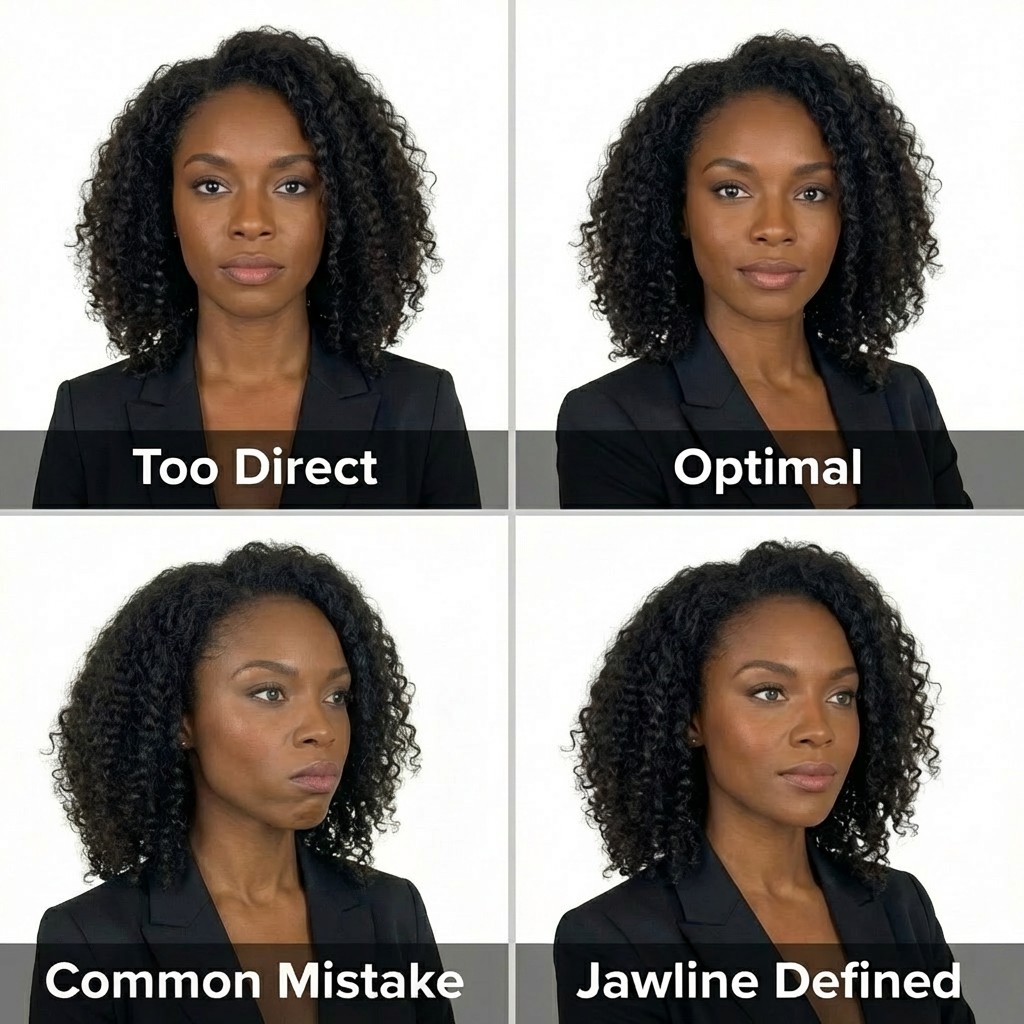
The 2/3 turn: Having your torso angled slightly away from the camera (roughly 30-45 degrees) avoids the aggressive straight-on look while maintaining presence. This angle is more flattering for most body types and reads as confident but approachable.
Jawline definition: Pushing your chin out and slightly down separates your face from your neck. This creates a sharper jawline and eliminates double-chin shadows. The technique works for everyone but matters more in feminine posing where softer features need more definition.
Shoulder positioning: Slight forward lean reads as engaged and interested. Squared-back shoulders read as confident but can edge toward aggressive. Women benefit from a slight forward lean to add warmth without sacrificing authority.
Wardrobe and Color: More Variables to Manage
Here's where men genuinely do have it easier. Male professional wardrobe is essentially: dark suit, white or light blue shirt, maybe a tie. Done.
Female professional wardrobe has exponentially more options. Which means more opportunities to get it wrong.
The data is clear on what works best:
Navy blue is universally considered the best color for professional headshots, receiving the highest trust ratings across industries.
Solid colors prevent moiré patterns. Fine repeating patterns like pinstripes or houndstooth cause wavy, rainbow-colored distortion on digital camera sensors. This distortion is nearly impossible to fix in post-production.
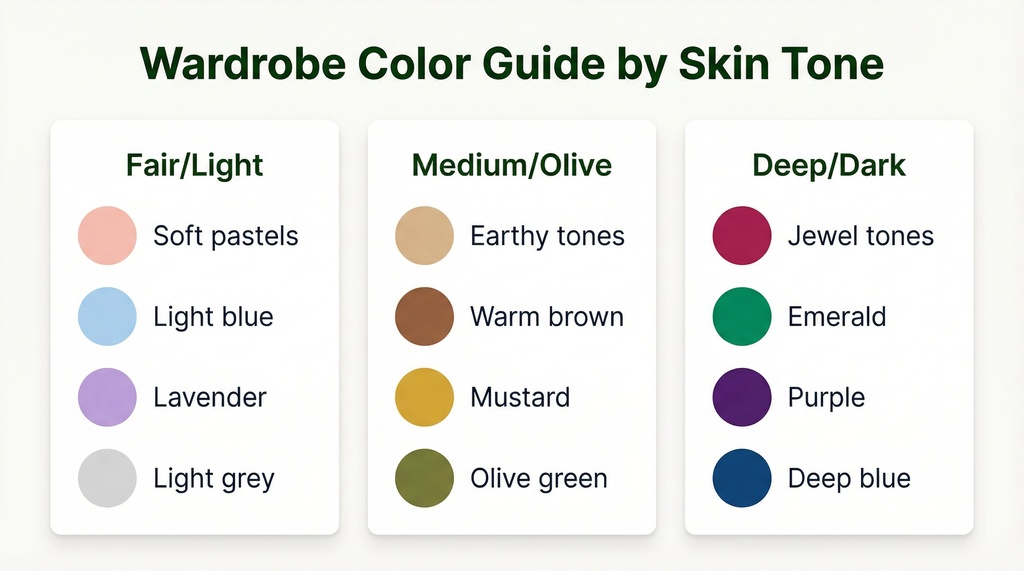
Skin tone matching adds another layer. Light complexions work with soft pastels. Medium complexions pair with earthy tones. Deep complexions pop against saturated jewel tones like emerald or amethyst.
There's also the neckline question. Open necklines draw attention to the face but can look strange with tight crops. High necklines read as highly professional but need to be fitted and unwrinkled.
| Industry | Best Choices | What to Avoid |
|---|---|---|
| Finance/Law | Navy blazer, structured jacket | Bright colors, patterns |
| Tech/Startup | Fitted sweater, casual button-down | Logos, neons |
| Creative/Media | Jewel tones, textures | Busy patterns, pure white |
I go deeper into specific outfit recommendations in our female wardrobe guide.
The Retouching Double Standard
The 2026 standard for professional headshots is "natural retouching." Preserve skin texture. Reduce distractions. Don't erase character.
Over-retouching carries a documented penalty. Research shows that heavy professional retouching causes significant drops in perceived trustworthiness, competence, and likability. Casting directors and recruiters are increasingly skeptical of photos that look "too perfect."
This matters because women face more pressure to retouch heavily. Cultural expectations around skin, wrinkles, and "flaws" push toward over-processing. But the data suggests this backfires professionally.
The solution: request texture-preserving techniques like Dodge and Burn, which smooth skin transitions without creating the plastic "Barbie-doll" effect of older blurring filters.
For makeup (whether for traditional photos or AI headshots), the camera-specific rules apply:
- Matte foundations beat dewy formulas, which look sweaty under lights
- Shimmer eyeshadows create hot spots and distracting reflections
- Black mascara ensures lashes read strongly
- Natural looks outperform bold experimentation in professional contexts
AI Headshots: The Bias Problem You Should Know About
AI headshot generators offer a cheap alternative to traditional photography. At InstaHeadshots, we've delivered over 4.4 million headshots. I think the technology works well for most professionals.
But the data on AI bias is worth understanding.
Text-to-image models trained on internet data exhibit significant demographic skew. When prompted for "a photo of a person," one major model generates male faces 65% of the time and White faces 47% of the time. For prompts involving high-prestige jobs, the bias compounds. "CEO" skews heavily male and white. "Social worker" skews female.
This matters because AI tools can subtly homogenize outputs toward stereotypical representations. A woman using an AI headshot service might get results that push her toward a narrower range of "acceptable" professional appearances than her actual range of options.
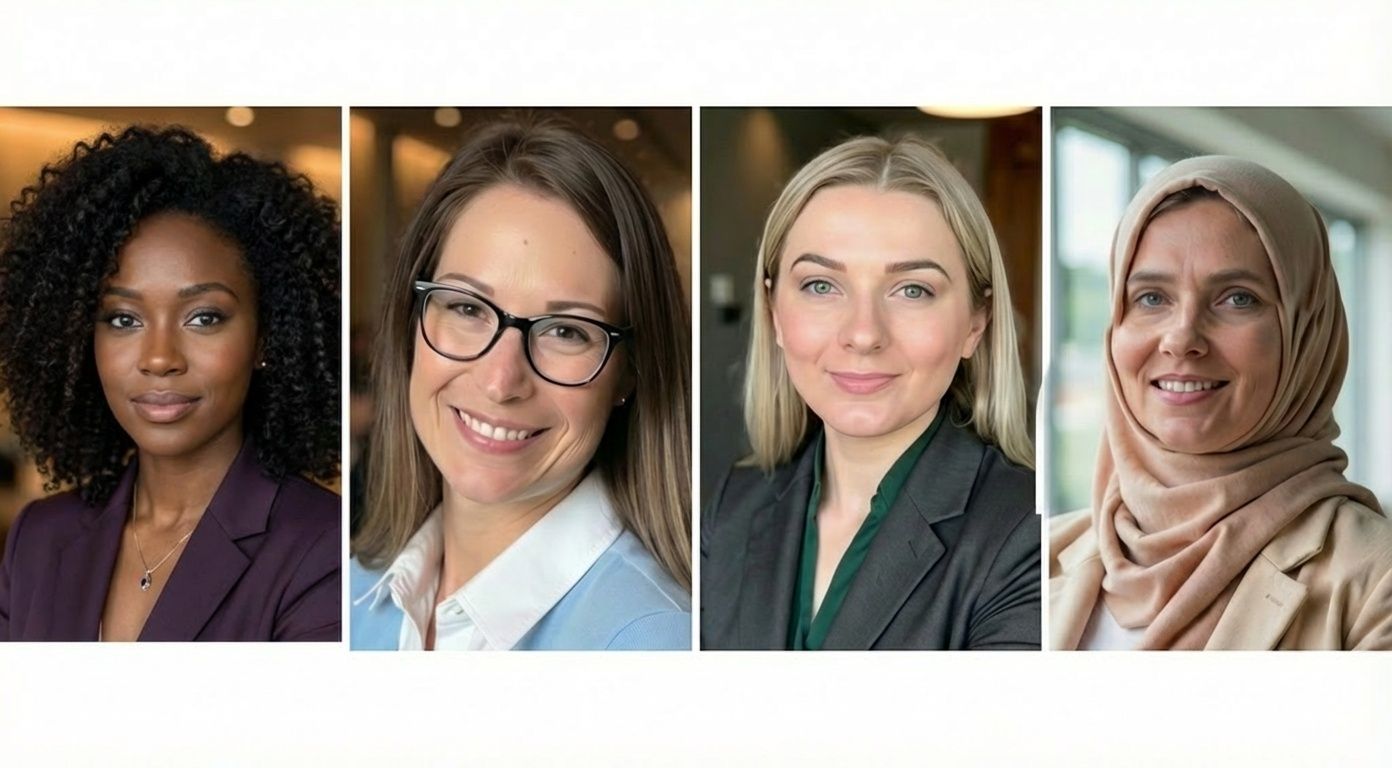
The other risk: AI can alter physical features in ways that create "filter shock" when you meet someone in person. Changed hairlines, straightened teeth, modified body shapes. While 76.5% of recruiters initially prefer AI headshot composition, 66% say they'd be put off if they discovered the photo was fake.
My take: AI headshots work well when they enhance lighting and background without altering your actual appearance. The technology is getting better at this. But it requires choosing the right tool and reviewing outputs carefully.
The ROI: Why This Technical Optimization Matters
All this technical detail serves a practical purpose. Professional headshots generate measurable career returns.
LinkedIn profiles with professional photos receive 14x more views and 36x more messages than those without. Humans form trustworthiness judgments from faces within 100 milliseconds. You don't get a second chance at that first impression.
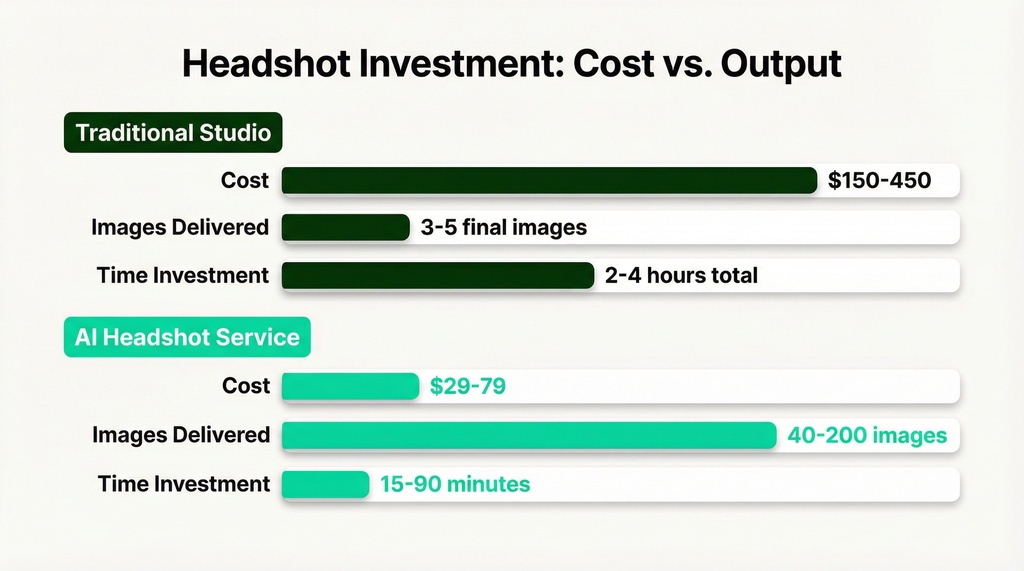
The median cost for a traditional headshot session is around $250, with most packages delivering 3-5 edited images. AI services like InstaHeadshots run $49-69 and deliver 40-200 options. Either can work. But understanding the technical differences between male and female headshots helps you evaluate photographers, give better direction, or select better AI outputs.
Your Action Plan
When booking your next headshot session or using an AI tool:
Request Butterfly or Loop lighting. Avoid dramatic Rembrandt or Split setups unless you're going for an edgy creative look.
Ask about focal length. If DIY, stand back and zoom in. Avoid wide-angle distortion.
Practice the Duchenne-squinch combo. Genuine smile plus slightly narrowed eyes. It feels awkward at first but photographs well.
Use the 2/3 body turn. Angle your torso slightly away from camera. Extend your chin forward and slightly down.
Wear solid colors. Navy is safest. Match to your skin tone. No fine patterns.
Request natural retouching. Texture-preserving techniques only. Heavy smoothing destroys credibility.
Review AI outputs carefully. Reject anything that doesn't look like the actual you.
The technical differences between male and female headshots aren't about making women look "softer" or more feminine. They're about understanding that different inputs require different optimization. Get the system right, and the output improves.
Constraints create clarity. Now you know what to ask for.