
What to Wear for Headshots: A Strategic Framework for 2026
Stop following outdated blazer advice. I break down how color, fabric, neckline, and industry context interact to create headshots that actually differentiate you.

The "just wear a navy blazer" advice needs to die. I've watched thousands of professionals run through our platform at InstaHeadshots, and the ones who stand out aren't following a single rule. They're working a system.
Here's the problem: most wardrobe advice treats headshots like a pass/fail test. Wear the safe colors, avoid patterns, minimize jewelry. Done. But that approach produces headshots that blend into every other LinkedIn grid. Generic inputs produce generic outputs. I've seen creative directors look stiff in suits and finance executives look forgettable in the same navy everyone else wears.
The truth is wardrobe decisions for headshots work more like compound variables. Color interacts with skin tone. Fabric behaves differently under studio lights versus AI generation. Neckline shape changes how your face is framed. Industry expectations shift what "professional" even means. Get one variable wrong and the whole equation breaks down.
I've put together a dimensional framework that helps you make wardrobe choices based on your specific context. Whether you're preparing for a traditional studio shoot or uploading selfies for AI generation, this guide covers what actually matters in 2026.
The Quick Answer: What Actually Works
If you need a starting point before diving deeper, here's the framework in brief:
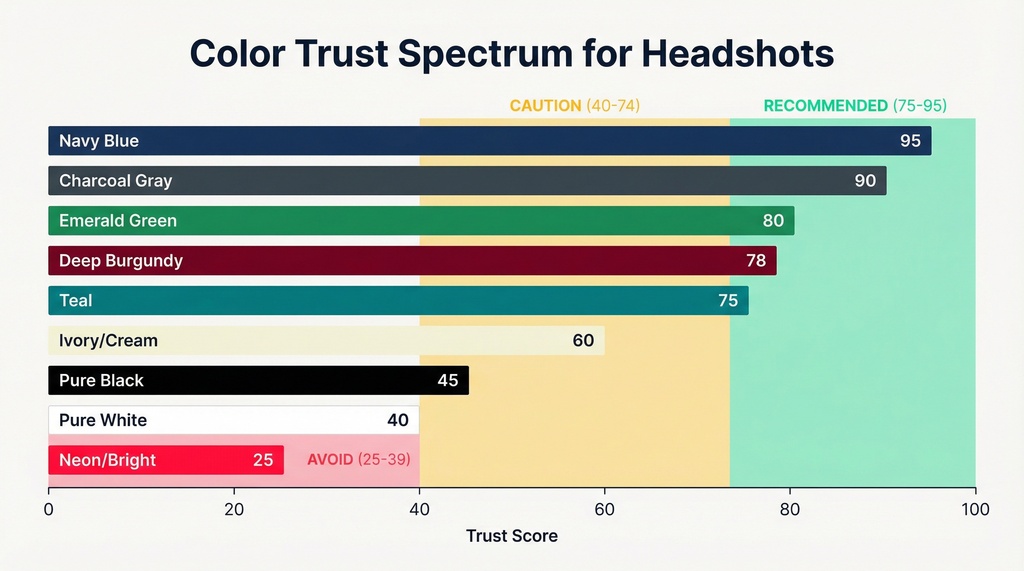
Colors that build trust: Navy blue consistently scores highest on trust perception metrics. Charcoal gray is the second safest choice. Jewel tones like emerald, burgundy, and teal add personality without undermining authority.
Colors to avoid: Pure white blows out under camera exposure. Pure black absorbs shadow and flattens dimension. Neons reflect unnatural color casts onto your skin.
Fabric rule: Matte cotton and wool blends absorb light evenly. Shiny or sheer fabrics create distracting hotspots.
Pattern rule: Solid colors are safest. Fine patterns like pinstripes cause technical artifacts that can't be fixed in editing.
Fit rule: Tailored beats baggy. Excess fabric looks sloppy in tight crops.
The meta-rule: Dress one level above your daily norm. A tech founder in a full suit looks as out of place as a banker in a hoodie.
Now let's break down each dimension.
Color Psychology: Why Dark Tones Win
Color isn't just aesthetic preference. It's a psychological trigger.
Research published in the International Journal of Engineering Research & Technology found that clothing with low value (darker shades) yields higher trust scores than lighter clothing. This isn't subtle. Darker tones create a measurable trust premium.
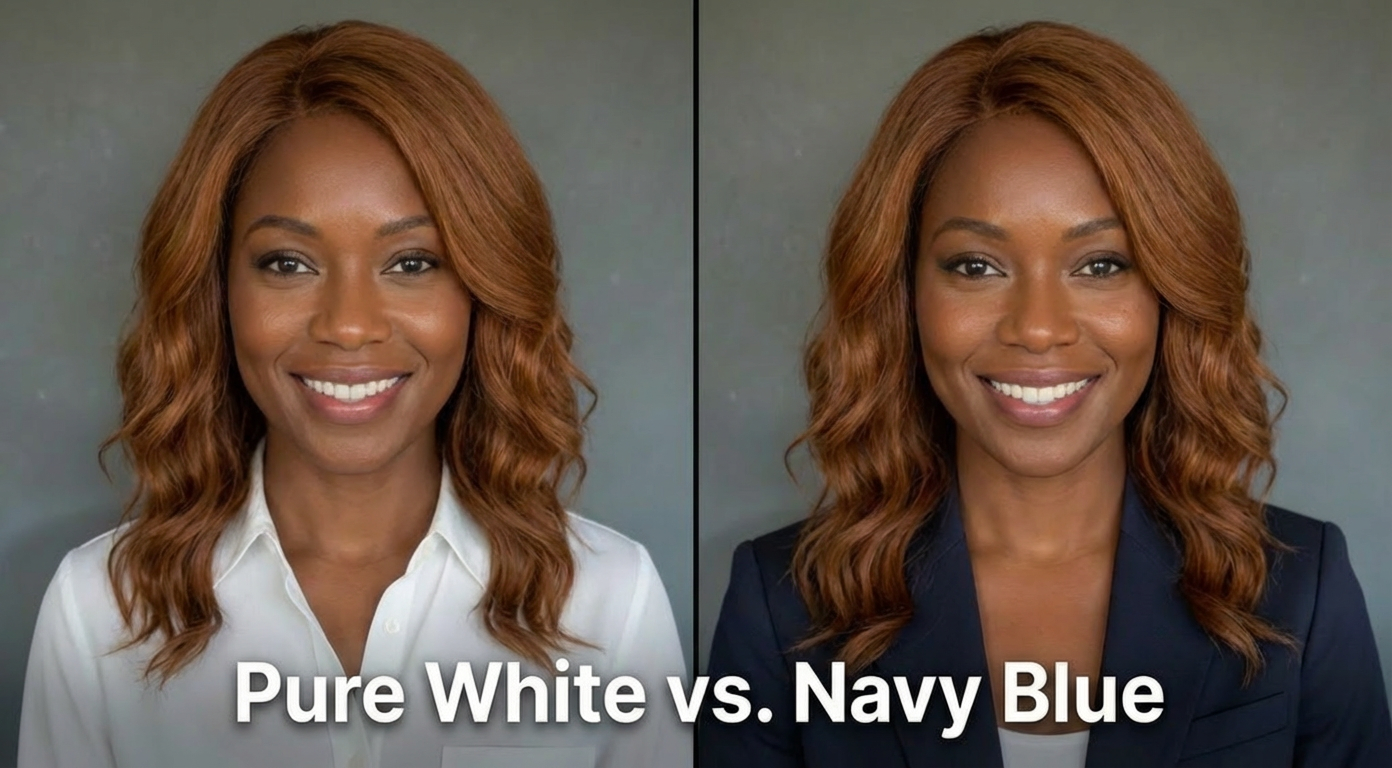
The power tier: Navy and charcoal work across every industry and complement all skin tones. If you're uncertain, these are your defaults.
The personality tier: Emerald green, deep burgundy, teal, and plum photograph beautifully. They create strong visual separation and communicate confidence without undermining authority. I cover color selection in more depth in our guide to headshot colors, including how to match colors to your specific skin undertone.
The risk tier: Pure white bounces light onto your chin and widens your lower face. Pure black creates a "floating head" effect against dark backgrounds. Neons cast unnatural hues onto your skin.
The fix for white is simple: layer under a dark blazer, or substitute with ivory, cream, or light blue. The fix for black is adding contrast through a lighter undershirt or visible collar.
Fabric and Texture: The Physics Problem
What looks luxurious in a mirror can become a technical liability under studio lighting.
This comes down to how fabric interacts with light. Matte surfaces scatter light evenly (diffuse reflection). Shiny surfaces create mirror-like highlights (specular reflection). Studio strobes amplify both effects.
Camera-safe fabrics: Matte cotton, cotton blends, and wool blends are the gold standard. They absorb light evenly, hold shape, and don't create distracting hotspots. Matte silk and crepe add subtle richness without problematic shine.
Fabrics to avoid: Sheer materials expose undergarments or skin in unpredictable ways. Highly wrinkle-prone fabrics create micro-shadows that look cheap under studio lighting. Anything shiny catches light unpredictably.
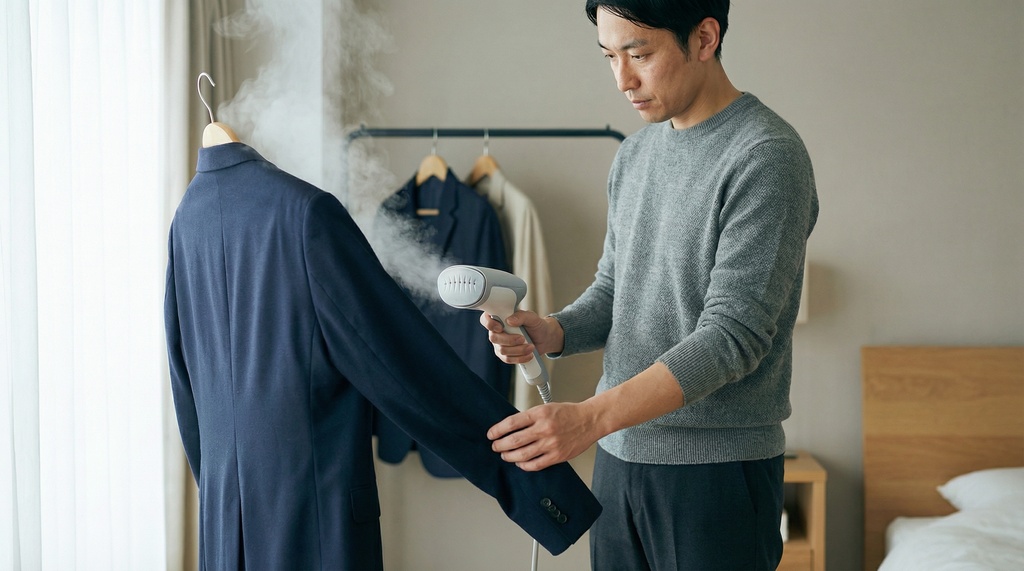
The wrinkle issue deserves emphasis. Studio strobes create shadows in every crease. A wrinkled shirt that looks fine in person reads as sloppy in a headshot. Steam or iron your clothes immediately before shooting. Carry them in a garment bag.
The Pattern Problem: Why Pinstripes Fail
Solid colors are the safest choice for a reason that has nothing to do with style. It's physics.
Digital camera sensors sample continuous images into discrete pixels. There's a mathematical limit called the Nyquist frequency that determines the finest detail a sensor can resolve. When you wear fine, repetitive patterns like pinstripes, houndstooth, or micro-checks, those patterns often exceed this limit.
The result is called moiré: wavy, rainbow-colored distortions that look terrible. The critical problem is that moiré gets baked into the raw sensor data. It cannot be fully corrected in post-processing.
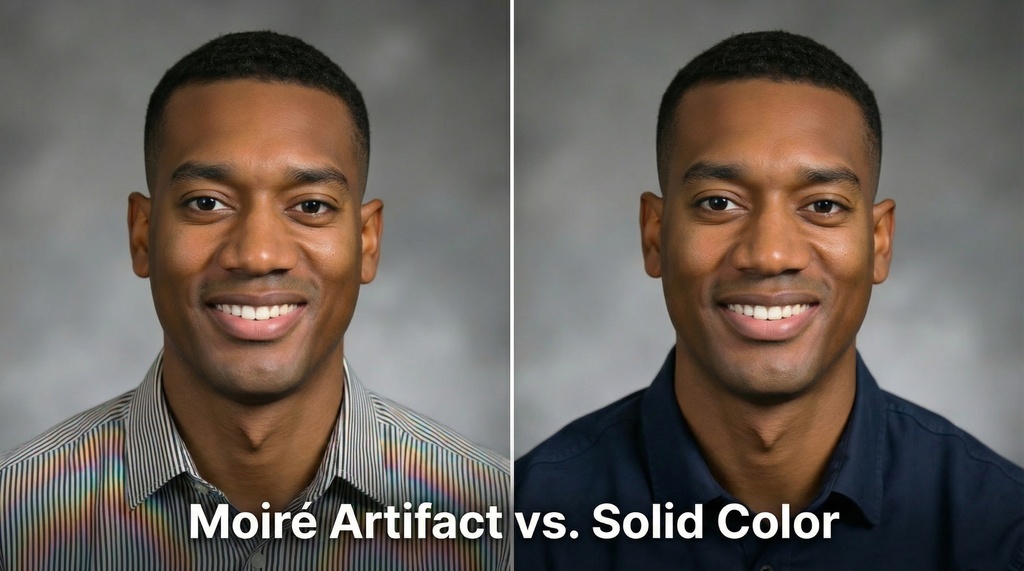
The actionable rule: Avoid tight patterns entirely. If a pattern must be worn, ensure it's large and widely spaced.
Necklines: The Frame Around Your Face
Headshots are tightly cropped. The neckline occupies a massive percentage of the visible frame. It's the architectural foundation of the portrait.
V-necks are the most universally flattering option. They draw the eye vertically, elongate the neck, and create a slimming effect.
Crew necks provide a clean, structured look ideal for long necks or narrower shoulders. But they add visual width across the chest and can make shorter necks appear compressed.
Boat necks create an elegant horizontal line that broadens the shoulders. They pair well with sleek hairstyles.
Turtlenecks are sophisticated but risky. They visually shorten the neck and can make the subject look out of proportion if not carefully styled and cropped.
For blazers and suits: Lapel width should balance your physical proportions. Narrow lapels on broad shoulders emphasize shoulder width by creating too much empty space. Wider lapels better match wider shoulders. The jacket shoulder seams must sit exactly at the edge of your shoulders. Poor shoulder fit is glaringly obvious in a tight crop.
Industry Context: The Variable No One Talks About
The "safe" wardrobe choice varies wildly by industry. A tech founder in a three-piece suit looks as out of place as a corporate lawyer in a cashmere hoodie.
I think of this as matching your visual language to your audience's expectations. Every industry has unwritten rules about what professionalism looks like. Your headshot either aligns with those expectations or creates cognitive friction.
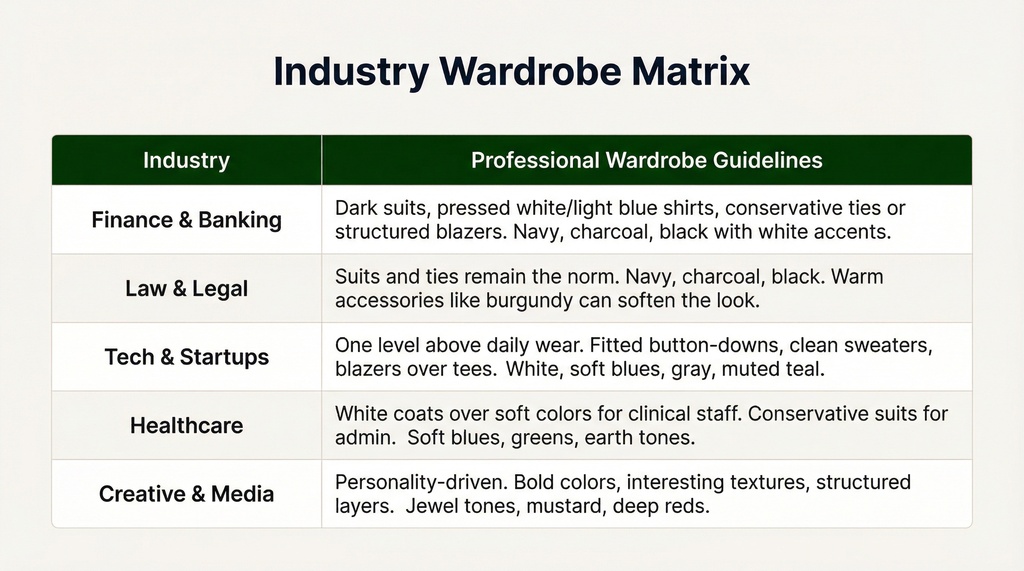
The overarching rule: dress one level above your daily norm, or one level above the clients you want to attract. This positions you as slightly more polished than expected without looking like you're trying too hard.
Accessories: Enhancement vs. Distraction
In a headshot, your face is the star. Everything else is supporting cast.
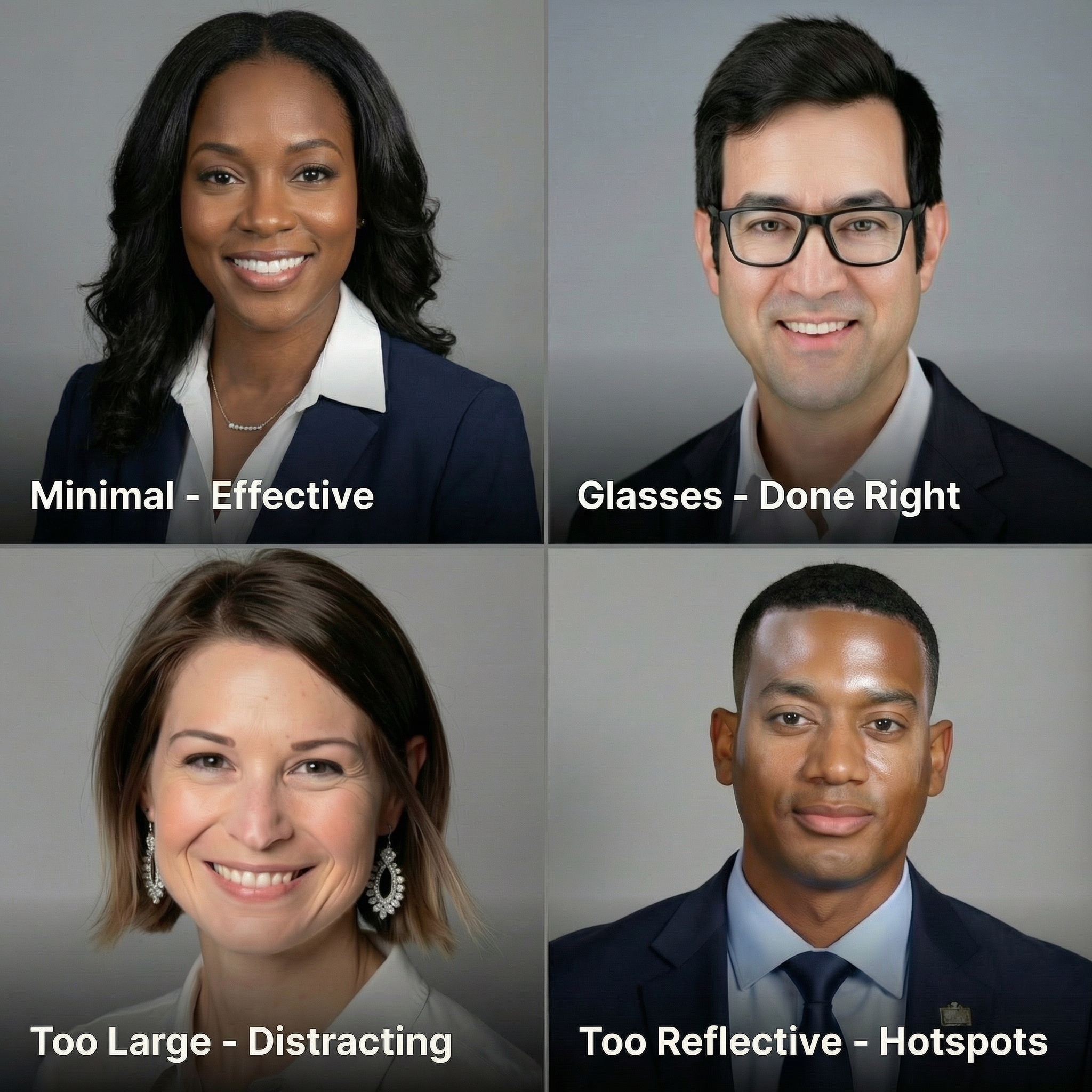
Jewelry: Keep it minimal. Simple studs, delicate chains, or a classic watch add polish without competing for attention. Avoid dangling earrings, large statement pieces, and reflective metals that catch light unpredictably.
Eyewear: If you wear glasses daily, wear them in your headshot for recognizability. Ensure lenses have an anti-reflective coating to prevent studio lights from obscuring your eyes.
Ties: Reserve for conservative industries. Choose classic stripes or small dots. Strictly avoid novelty ties.
The exception: in creative industries, a distinctive accessory can become a memorable brand signature. But this is a high-risk, high-reward play. Default to restraint unless you're confident the accessory strengthens your professional story.
AI-Generated vs. Traditional: Different Rules
By 2026, AI headshot generators have evolved from uncanny novelties to enterprise-grade tools. The best platforms produce images that are virtually indistinguishable from professional photography at normal viewing sizes.
But the wardrobe rules shift.
With AI generation, your physical wardrobe matters less because the AI can generate different outfits. What matters is your input photos. The AI uses your selfie's neckline and posture as source data. Wearing a relatively fitted, solid-colored top with a defined collar or V-neck gives the AI cleaner structural lines to build upon than a baggy hoodie.
Input rules for AI headshots:
- Upload 10-15 selfies taken in natural light from varied angles
- Wear solid colors with defined necklines in your input photos
- Avoid complex textures that AI still struggles to render consistently
- Be consistent with glasses and facial hair across inputs
AI still struggles with complex micro-textures, rendering hands near the face, and maintaining consistency with glasses or facial hair if inputs are mixed. Services like InstaHeadshots can generate hundreds of variations from your inputs, but the quality ceiling depends on what you upload.
When to use AI: Speed, cost-efficiency, team scaling, or when you need many options to choose from.
When to use traditional: High-end executive press kits, complex bespoke wardrobes, or when absolute literal accuracy is required.
I've written more about preparing for headshot sessions that applies whether you're going AI or traditional.
Platform Constraints: Where Your Headshot Lives
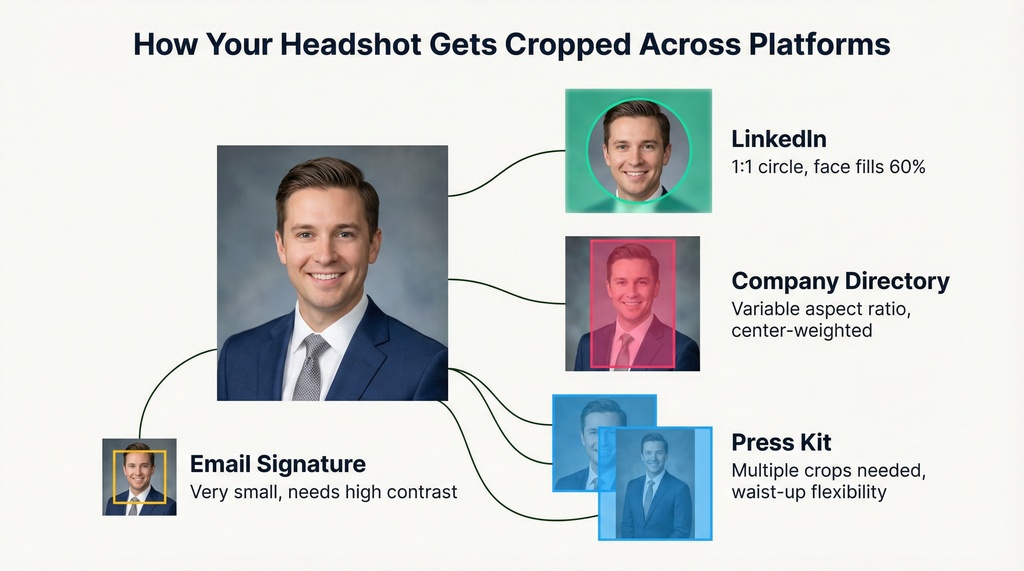
Your headshot doesn't exist in a vacuum. Where it appears dictates how it should be styled.
LinkedIn: The profile photo displays as a tiny circle, heavily viewed on mobile. Profiles with professional photos receive 14 to 21 times more views than those without. Because the crop is so tight, collars and necklines are the only visible wardrobe elements. High-contrast layers (dark blazer over light shirt) ensure you don't blend into the background. Your face should occupy 60% of the frame.
Company Directories: Often use responsive design. Images may be cropped to 16:9, 4:3, or 1:1 depending on the layout. Keep critical wardrobe details like ties or branded pins near the center vertical axis to survive automated cropping.
Press Kits and Speaker Bios: Require versatility. Capture multiple crops (waist-up, 3/4 framing) to give marketing teams flexibility for slides, banners, and print.
Common Mistakes and Quick Fixes
| Mistake | Why It Fails | The Fix |
|---|---|---|
| Pure white shirts | Blows out exposure, bounces light onto chin | Layer under dark blazer or use ivory/cream/light blue |
| Fine pinstripes | Exceeds sensor resolution, causes unfixable moiré | Solid colors or large, widely spaced patterns only |
| Baggy/oversized fits | Adds visual bulk, looks sloppy in tight crop | Choose tailored, snug fits. Structure flatters. |
| Wrinkled fabric | Studio lights create shadows in every crease | Steam/iron immediately before shooting |
| Front-facing phone selfies | Distorts facial proportions (wider face, larger nose) | Use rear camera from distance, or use professional/AI service |
The 2026 Trend: Authenticity Over Perfection
The era of heavy, plastic-looking retouching is over. 2026 trends favor natural skin texture, relaxed micro-expressions, and approachability. WGSN data highlights "Future Dusk" (a dark blue-purple) and confirms that 44% of runway colors are dark shades, aligning perfectly with the high-trust metrics of darker corporate wear.
This matches what I'm seeing in the data. The headshots that perform best aren't the most polished. They're the ones that look like the person you'd actually meet. Discomfort shows on camera. Pieces that help you feel like your real-life self consistently outperform uncomfortable "power" outfits.
Your Framework
Forget the single-rule approach. Instead, run through this checklist:
- Industry alignment: What does "professional" mean in your specific field?
- Color strategy: Dark tones for trust, jewel tones for personality, avoid pure white/black extremes
- Fabric check: Matte surfaces, wrinkle-resistant, no shine
- Pattern audit: Solid colors safest, large patterns only if necessary
- Neckline choice: V-necks most universally flattering, match to your proportions
- Fit confirmation: Tailored, not baggy. Shoulder seams at shoulders.
- Accessory edit: Minimal, non-reflective, enhancing not competing
- Platform consideration: Will this survive tight LinkedIn cropping?
- Format awareness: AI inputs need solid colors and defined necklines
Constraints create clarity. Once you understand how these dimensions interact, wardrobe decisions stop being stressful and start being strategic.
The goal isn't to follow rules. It's to make choices that project the specific professional image you want, for the specific audience you're trying to reach, on the specific platforms where they'll see you. That's not a blazer. That's a system.