
Financial Advisor Headshots: The Trust Signal Most Advisors Get Wrong
Most financial advisor headshots over-signal competence and accidentally read cold. Here's how to look warm, credible, and FINRA-compliant at the same time.
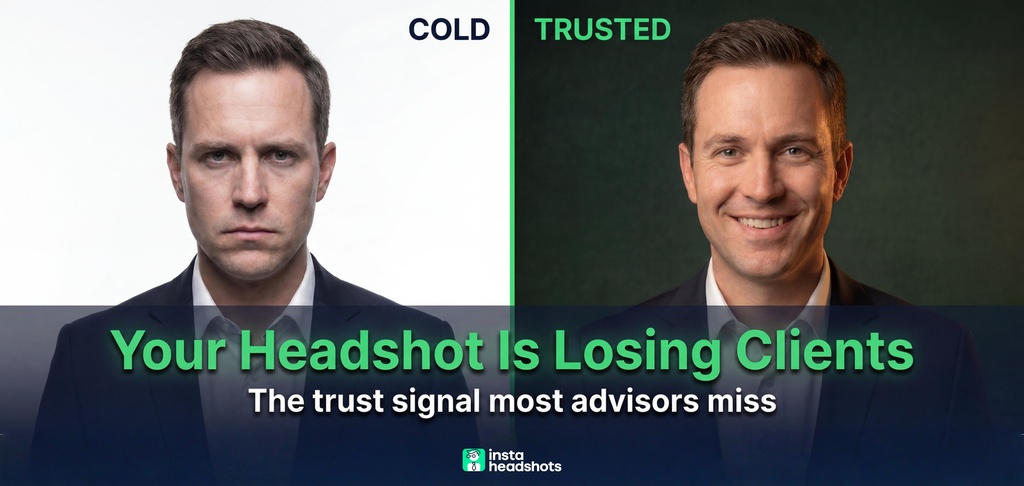
I looked at hundreds of financial advisor headshots before writing this. Most of them made the same mistake. They were technically fine. Sharp focus, good suit, neutral background. And almost all of them read cold.
That surprised me. These are smart, capable people. But their photos signaled "I can manage money" while completely missing "I'm on your side." In a field where someone is deciding whether to hand you their life savings, that gap is expensive.
Here's what I found after digging into the trust research, the FINRA and SEC rules, and the actual styling choices that move the needle. The headshot that wins clients isn't the most formal or expensive one. It's the one that signals two things at once, without crossing a compliance line you didn't know existed.
Let me show you exactly how to get there.
The Short Answer: Warm AND Competent, Not One or the Other
Most advisors believe trust comes from looking serious and corporate. That's half right. Trust is built on two signals, and most headshots only fire one.
The first is competence: you know what you're doing. The second is warmth: you have my interests at heart. People judge both from your face, fast.
Here's the part most advisors miss. Warmth carries more weight. Research behind the Stereotype Content Model shows warmth accounts for 59% of the variance in how we judge people. Competence accounts for only 29%. Warmth is judged first, and it matters most.
The stiff, serious headshot maximizes competence and kills warmth. It lands you in the "competent but cold" zone. That's the quadrant tied to envy, not trust. Your prospect thinks you can manage money but isn't sure you'll look out for them.
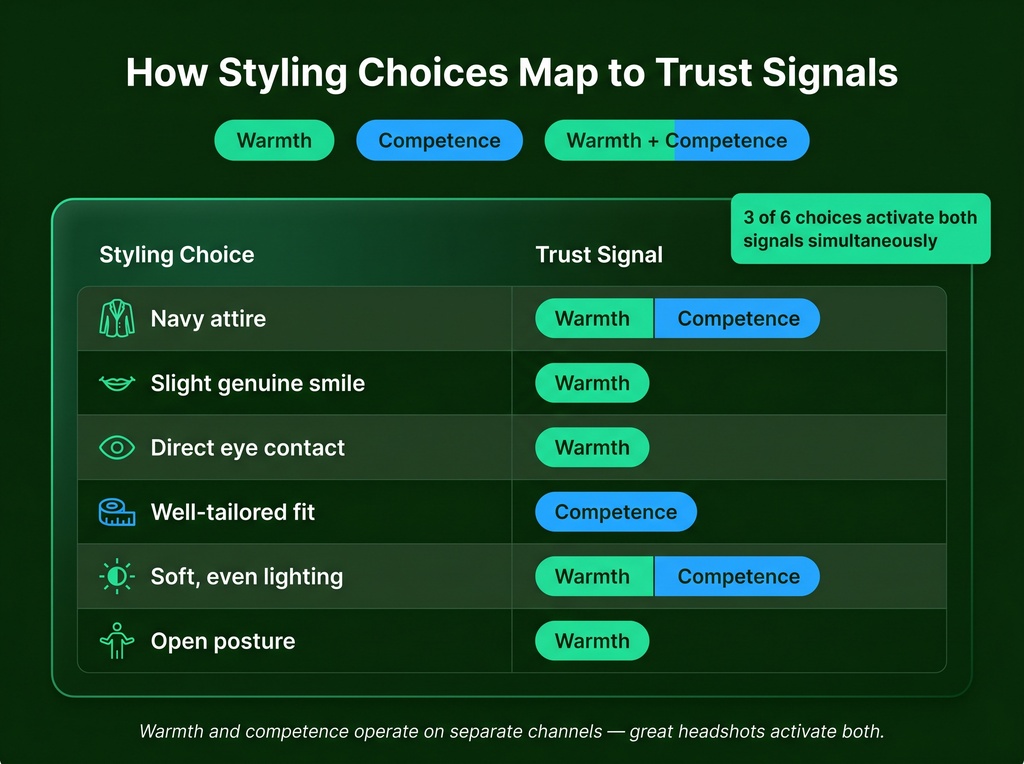
The good news: warmth and competence run on different channels. You don't trade one for the other. You engineer both.
| Signal | Warmth Comes From | Competence Comes From |
|---|---|---|
| Expression | Slight genuine smile, eye crinkle | Composed, not stiff |
| Eyes | Direct gaze at the lens | Steady, engaged |
| Posture | Relaxed shoulders, open frame | Upright, intentional |
| Attire | Navy blue | Well-tailored, formal |
| Lighting | Soft, even | Clean, professional |
That's the whole game. Now let me prove each piece.
You Have 100 Milliseconds. Use Them.
This statistic reframed the entire problem for me. A Princeton study by Willis and Todorov found that people judge trustworthiness from a face in 100 milliseconds. One-tenth of a second.
More exposure barely helped. Their data showed judgments at 100ms explained 72.7% of the variance. At a full second, that rose only to 74.9%. The first impression locks in almost instantly.
Trustworthiness was the fastest trait judged, faster even than attractiveness. The correlation hit r = .73. In other words, your face is broadcasting a trust verdict before a prospect reads a single word of your bio.
This matters because of where prospects find you. In financial advice, 96% of prospective clients research advisors online before hiring, and 60% rank trust as their single most important factor. Your headshot is the gatekeeper. It's the first handshake, and as I cover in our guide on headshots that signal trust, in many cases people decide who to contact based on visual cues alone.
Patterns repeat. Most people just don't notice them. The pattern here: your face does the selling before you ever get the call.
The Smile Question: Settled by Research
The oldest advice in finance is "look serious to look trustworthy." The research says the opposite.
A genuine smile, the kind that crinkles your eyes, is the strongest warmth signal you control. The Max Planck Institute found faces with a genuine smile were rated about 10% more trustworthy than neutral ones. In economic trust games, that smile raised cooperation by roughly 30%.
Here's what surprised me. The smile doesn't have to be spontaneous to work. A good photographer can coach a genuine-looking expression, and it still reads as authentic and trustworthy.
But calibration matters. A broad, toothy grin can backfire in finance. A 2023 study I found referenced shows a broad smile makes you look warmer but less competent, a "compensation effect" that hits utilitarian fields like finance hardest. So you want the middle setting.
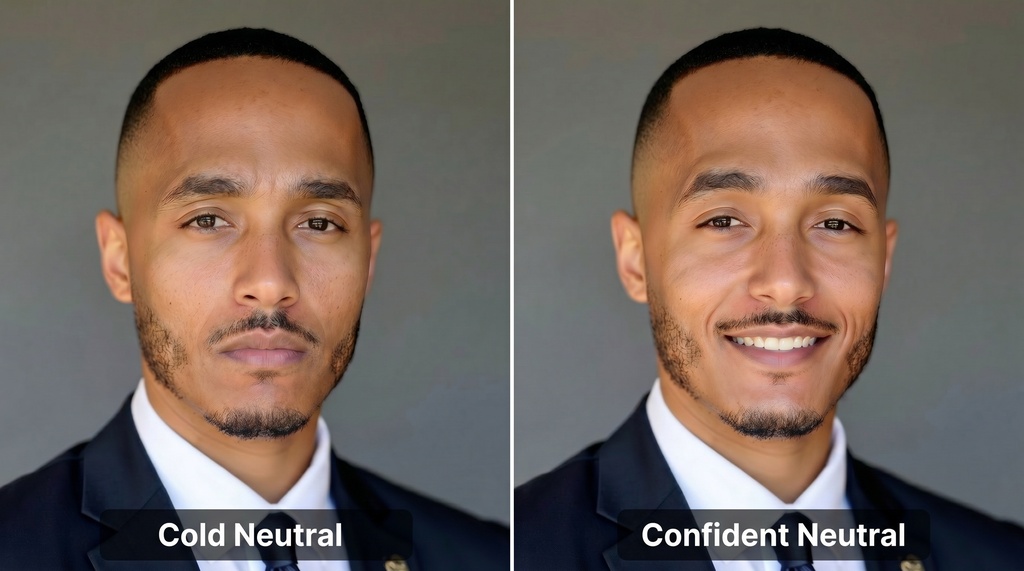
The target is what some call the "Confident Neutral": a composed expression with a slight, natural smile. Warm eyes, relaxed mouth, steady gaze. I break down the exact mechanics in our piece on the slight smile for trustworthy headshots.
A flat, no-smile expression isn't competence. In a trust-critical field, it reads as coldness. Don't confuse a stern face with a serious professional.
Attire and Color: Why Navy Wins
Formal dress works. It raised perceived competence by a clear margin in the research I reviewed. But the smartest variable here is color, not formality.
Navy blue is the single best wardrobe choice for advisors. It signals both trust and authority at once. Color research across three studies found blue increases trust more than red. That's a rare case where one choice serves both signals.
Here's my practical breakdown:
- Men: Navy or charcoal suit, white or light blue shirt, solid or subtle tie. Matte fabrics, not shiny.
- Women: Solid navy, charcoal, or deep jewel tones. Simple neckline, minimal jewelry.
- Newer advisors: Lean more formal. You're building credibility from zero.
- Established advisors: You can dress slightly less formal once your reputation does the work.
Keep the styling clean. Mid-tones and solids photograph better than pure black, pure white, or busy patterns, which I cover in our what to wear guide. Fit matters more than the label. In a tight crop, anything that pulls or sags shows.
The Compliance Layer Nobody Talks About
This is where I found a real gap. Photography guides ignore compliance. Compliance guides ignore photos. But your headshot is regulated, and most advisors have no idea.
A headshot on your firm site, LinkedIn, or bio page counts as a "retail communication" under FINRA Rule 2210. The rule bans any "false, exaggerated, unwarranted, promissory or misleading" claim. That applies to images, not just text. Retail communications often need written principal approval before use.
The SEC Marketing Rule, Rule 206(4)-1, adds another layer. It prohibits content "likely to cause an untrue or misleading implication or inference to be drawn." A photo that implies resources or performance you don't have can cross that line.
This isn't theoretical. FINRA fined M1 Finance $850,000 in 2024 over misleading social media content. The SEC charged more than a dozen advisers for Marketing Rule violations that same year. Visual content is inside the enforcement scope.
Here's what could quietly make your headshot non-compliant:
| Risky Choice | Why It's a Problem |
|---|---|
| AI luxury office, skyline, or yacht background | Implies resources or lifestyle that may not be real |
| Stock tickers or upward charts as props | Suggests guaranteed returns, a promissory claim |
| Heavy retouching that changes your face | Image no longer represents you accurately |
| Settings implying a big firm when you're solo | Unsubstantiated claim of seniority or scale |
| A headshot that doesn't look like you | Misleading as to identity when you meet in person |
None of these are obvious. That's exactly why they're dangerous. A fake skyline behind you feels like smart branding. Under these rules, it's a misleading impression. Optionality is power, but only when every option stays inside the guardrails.
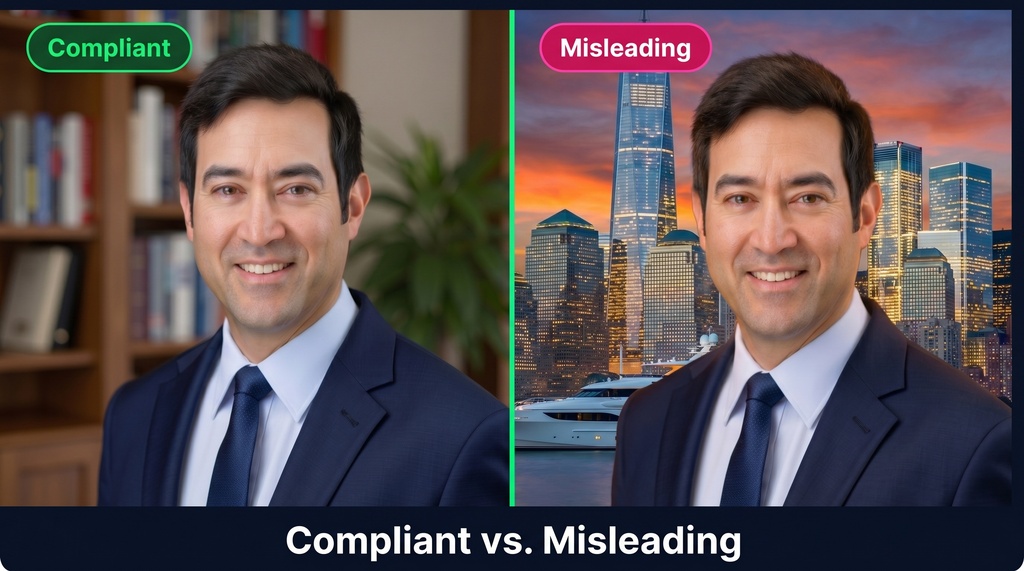
The safe move on background is simple. Use a neutral tone (navy, charcoal, gray) or your real, softly blurred office. A genuine workspace is compliance-safe because it's true. A staged luxury set is not.
Matching the Headshot to Your Clients
Who you serve should shift your calibration. Not the rules, just the dial.
Serving retirees and older clients: Lean formal. Darker backgrounds, full business professional attire, a restrained smile. This group reads formality as stability and trust.
Serving younger professionals: Lean approachable. Softer backgrounds, smart-casual attire, a slightly warmer smile. 71% of millennials prefer handling finances online, so your digital first impression carries even more weight.
The compliance rules don't change with your audience. You can adjust warmth and formality freely. You cannot create false impressions for any client type.
Photographer or AI: The Real Trade-Off
Cost is the elephant in the room. Traditional headshots run around $283 on average in the US, and many sessions deliver only one to three final images. AI services run far cheaper, often $25 to $79.
For advisors, AI carries one specific risk worth naming: identity accuracy. If an AI image doesn't truly look like you, that's not just a quality problem. It's a potential misleading-impression problem under FINRA and SEC rules. If you meet a prospect and look different from your photo, trust erodes before you speak.
My honest take: AI headshots can absolutely work for advisors, but only if the output genuinely looks like you. The method matters less than whether the final image hits the quality bar. Recruiters preferred AI headshots over real photos 76.5% of the time in blind tests, which tells you AI quality is no longer the issue. Identity accuracy is.
If you go the AI route, tools like Headshots by Magic Studio let you generate dozens of styled variations from your own photos, then test compliance-safe navy-and-neutral looks against warmer ones. The key step: have a colleague confirm the image actually looks like you before it goes live. If it doesn't pass that test, don't use it.
The Headshot That Actually Wins Clients
Let me bring this back to one principle. Complex problems usually have simple governing variables. For advisor headshots, the governing variable is signaling competence and warmth at the same time, inside the compliance lines.
Here's your checklist:
- Expression: Slight genuine smile with eye crinkle. Not stern, not a grin.
- Eyes: Look straight into the lens. Treat it as the client's eyes.
- Posture: Relaxed shoulders, open frame, upright spine.
- Attire: Navy, well-tailored, matte fabric, solid colors.
- Lighting: Soft and even. No harsh shadows under the eyes.
- Background: Neutral tone or your real, blurred office. Never a fake luxury set.
- Retouching: Light. Keep your real features so you still look like you.
The advisor who thinks the choice is "professional OR approachable" is working from a false premise. You can have both. They run on different channels.
In markets and careers, survival is underrated, and the same is true here. The winning headshot isn't the flashiest one. It's the one that quietly signals you're capable, you're trustworthy, and what you're showing is real. Get that right, and your face starts working for you in the first tenth of a second.