
Female Headshots: A Practical Guide to Women's Professional Photos
A good female headshot pairs soft, defined light with a real smile, a slight body turn and solid colors. Lighting, poses, outfits and what research says.

A strong female headshot comes down to five choices: soft light that still defines your face, a lens and distance that do not distort it, a slight turn of the body, a real smile matched to your field, and solid colors that suit your skin tone. None of this is different in kind from a man's headshot. What differs is that women usually have more wardrobe options to get wrong, and research on how faces are judged suggests women have a narrower range between looking warm and looking competent.
This guide covers each choice, with what to ask a photographer for and what to check if you are using AI.
The quick version
| Area | What works | What to avoid |
|---|---|---|
| Lighting | soft butterfly or loop light, with a little edge light to define the jaw | flat glamour light, or harsh split light for a business photo |
| Lens | 85 mm or longer, or stand back and zoom in on a phone | close-up wide-angle shots |
| Pose | torso turned 30 to 45 degrees, chin slightly forward and down, a small lean in | standing square on, chin pulled back |
| Expression | a genuine smile that reaches the eyes, with a slight squint | a polite mouth-only smile, wide eyes |
| Clothes | solid colors that suit your skin tone, a fitted neckline | fine patterns, logos, neon, busy necklines |
| Retouching | natural: remove blemishes, keep texture | smoothing that removes pores and lines |
Why the balance between warmth and competence matters
Psychologists describe two main dimensions people use to judge others: warmth (do they mean well?) and competence (can they deliver?). In their review of the Stereotype Content Model, Amy Cuddy, Susan Fiske and Peter Glick write that nontraditional women, career women among them, "are acknowledged to be competent, but are viewed as lacking warmth".
For a headshot, the practical point is this: an expression and styling that read as simply "serious" on a man can read as "cold" on a woman, and a very broad smile can undercut authority. The choices below are about landing in the space where you look both approachable and capable.
Lighting: soft, with some definition
Lighting shapes how a face reads more than most people expect. Four classic portrait patterns:
| Pattern | Where the main light sits | Effect |
|---|---|---|
| Butterfly | in front of and above the face | a small shadow under the nose, lifted cheekbones, smooth skin |
| Loop | about 45 degrees to one side, slightly above eye level | a small shadow beside the nose, warm and versatile |
| Rembrandt | further to the side | a triangle of light on the far cheek, more dramatic |
| Split | at 90 degrees | half the face in shadow, moody and edgy |
For a business headshot, butterfly or loop lighting is the usual choice. Rembrandt and split lighting suit creative, editorial or acting work better.
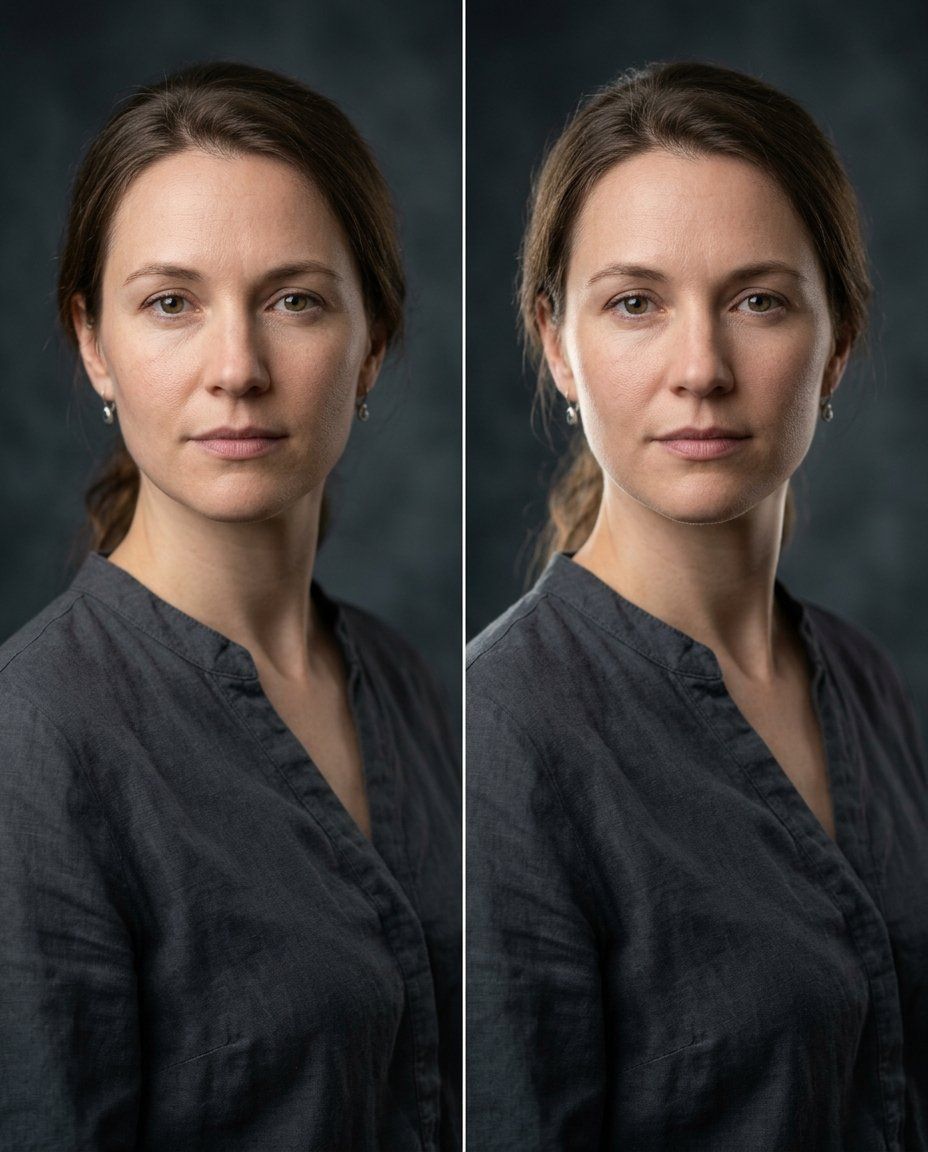
Soft light on its own can flatten a face. If you want more executive presence, ask for soft main light plus a subtle edge (or "kicker") light from behind and to one side, which defines the jawline without hard shadows on the face.
Lens and distance: the hidden distortion
Shooting close with a wide lens changes the shape of a face. In a 2016 study by Třebický and colleagues, photos taken at 50 mm made faces look rounder, with larger, wider-set eyes and a broader nose, and were rated less attractive than photos taken at 85 mm and 105 mm.
A professional headshot photographer will usually use a longer lens. If you are taking your own photo, do not hold the phone close. Prop it up a few feet away, use the rear camera, and zoom in slightly or crop afterwards. Our guide to taking a great headshot yourself covers the setup.
Posing: small angles, big differences
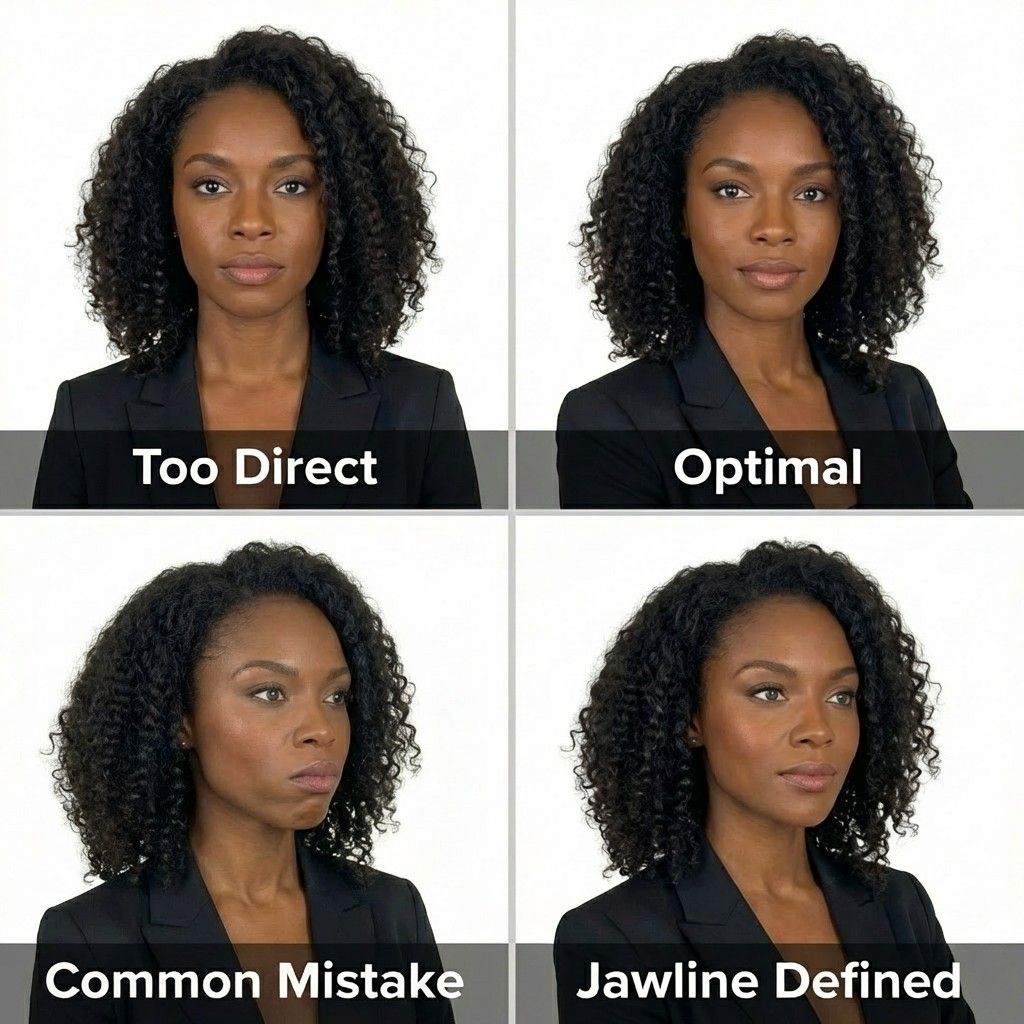
- Turn your torso 30 to 45 degrees away from the camera and bring your face back toward it. Standing square on can look confrontational; the turn reads as confident and approachable, and suits most body types.
- Push your chin slightly forward and down. It separates your jaw from your neck and removes the shadow under the chin. Pulling the chin back, a common nervous reflex, does the opposite.
- Lean in a little. A slight forward lean reads as engaged. Shoulders pulled far back can look stiff.
- Try crossed arms in a wider crop, softened with a smile. The arms add strength; the smile keeps it warm.
For more positions by industry, see headshot poses that work.
Expression: how big to smile
"Just smile" is incomplete advice, because smile size changes how you are read.
In a study in the Journal of Consumer Research, Wang and colleagues (2017) found that a marketer with a broad smile was seen as warmer but less competent than one with a slight smile. The drop in perceived competence was more likely in high-risk situations, where people care most about getting it right.
Read into a headshot, that suggests:
- Fields where clients trust you with risk (law, finance, medicine, senior leadership): a confident, softer smile, often closed-mouth or with a little teeth.
- Fields built on warmth and service (real estate, hospitality, sales, teaching, coaching): a wide, genuine smile works in your favor.
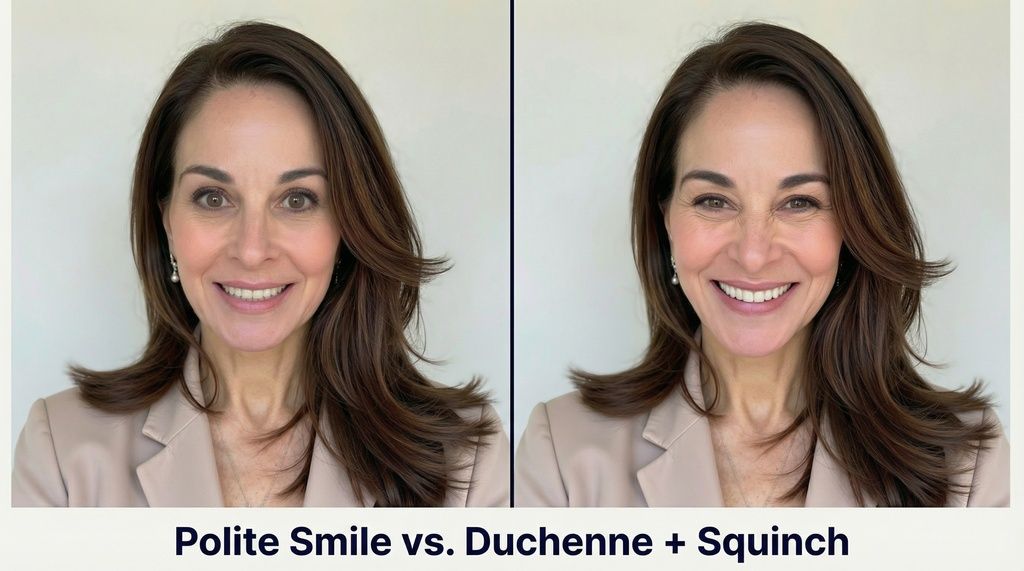
Whatever the size, make it real. A meta-analysis by Gunnery and Ruben found that Duchenne smiles, which activate the muscles that crinkle the corners of the eyes, are rated more positively, including as more genuine and trustworthy, than smiles made only with the mouth.
Photographers often pair this with a "squinch": a slight narrowing of the lower eyelids, popularized by headshot photographer Peter Hurley. Wide-open eyes can look startled; a slight squinch looks relaxed and sure of yourself.
What to wear
Women's professional wardrobes have more variables than men's, which means more chances for something to pull focus.
- Solid colors. Fine repeating patterns such as pinstripes, small checks and houndstooth can cause moiré, a wavy rainbow shimmer on digital sensors that is hard to fix afterwards.
- Navy is the safe default, with charcoal gray close behind. Both suit most skin tones and most industries.
- Match color to your complexion. As a rough guide: fair skin with soft pastels and mid-tones, medium and olive skin with earthy tones, deep skin with saturated jewel tones such as emerald, sapphire or plum.
- Pick the neckline for the crop. Open necklines draw attention to the face but can look bare in a tight crop. High necklines look very professional but need to be fitted and smooth.
- Keep jewelry small. Studs or a fine chain.
| Industry | Expression | What to wear |
|---|---|---|
| Law | neutral to soft, closed-mouth smile | a dark structured blazer, a high or simple neckline |
| Finance | confident, subtle smile | a tailored suit or structured jacket |
| Tech and startups | friendly, approachable smile | smart casual: a fitted sweater, or a blazer over a blouse |
| Healthcare | gentle, warm smile | a white coat over soft blue or green, or business casual |
| Real estate | wide, genuine smile | a polished blazer, confident color |
| Creative and media | open smile or mid-laugh | jewel tones and texture, nothing that strobes |
In tech, a T-shirt or hoodie is common in men's headshots; for women, a smart casual look (a fitted knit or a soft blazer) tends to photograph as more deliberate. More outfit detail is in our guide to what to wear for professional headshots for women, and lawyers can see women lawyer headshots.
Hair, makeup and retouching
Camera rules for makeup differ a little from everyday ones:
- Matte foundation. Dewy formulas can look shiny or sweaty under lights.
- No shimmer eyeshadow, which creates bright spots.
- Black or dark brown mascara so lashes read.
- Natural over experimental for a professional photo.
For retouching, ask for a natural finish: remove blemishes, stray hairs and shine, and keep skin texture, freckles and smile lines. Techniques such as dodge and burn even out skin without the blurred, plastic look of heavy smoothing. Heavily retouched photos can look unlike you in person, which defeats the purpose of a headshot.
AI headshots: what women should check
AI headshots are a cheaper and faster way to get a professional photo, and they work well for many people. They also inherit patterns from the images they were trained on, so it is worth knowing what to look for.
- Gender and race skew. In one 2024 analysis, Stable Diffusion XL, asked for "a photo of a person", produced male faces in 65% of images and White faces in 47%.
- Younger and smiling. A 2025 study of AI images of people at work found that in one model's output (Ideogram), 74.5% of women were smiling against 33.3% of men, and 19% of women showed signs of aging against over 44% of men.
These studies tested general image generators from text prompts, not headshot tools trained on your own photos. They are still a good checklist for any result:
- Does your skin tone match your real skin?
- Is your hair texture yours (curls, coils, waves, gray)?
- Do you look your actual age?
- Are your face shape, teeth and features unchanged?
- Is the smile one you would actually make?
Reject any photo that fails one of these. Headshots by Magic Studio works from about ten of your own photos and gives you 50 headshots across 5 looks in about 15 minutes. You see them before paying, so you can check every one against this list first, and packs start at $49: a starter pack of 3, all 50 for $59, or all 50 in print-ready high resolution for $69.
Your checklist
- Ask for butterfly or loop lighting, with a subtle edge light if you want more authority.
- Stand back and zoom in, or ask about the lens. Avoid close wide-angle shots.
- Turn your torso 30 to 45 degrees, chin slightly forward and down.
- Choose your smile size for your field, and make it reach your eyes.
- Wear solid colors that suit your skin tone. Navy is the safe choice.
- Ask for natural retouching.
- If using AI, reject anything that changes your skin tone, hair, age or features.
Common questions
What should a woman wear for a professional headshot?
Wear a solid-colored top or jacket that fits well, in a color that suits your skin tone. Navy and charcoal suit most people and most industries; jewel tones suit deeper skin tones and creative fields. Avoid fine patterns, which cause moiré on camera, as well as logos, neon colors and busy necklines, and keep jewelry small.
Should women smile in professional headshots?
Yes, but match the size of the smile to your field. Research on smile intensity found that broad smiles make people seem warmer but less competent, especially in high-stakes situations, so a softer, confident smile suits law, finance and leadership, while a wide smile suits real estate, sales and service roles. In both cases, a genuine smile that reaches the eyes reads better than a polite one.
What is the best lighting for female headshots?
Butterfly lighting (the main light in front of and above the face) and loop lighting (about 45 degrees to the side) are the usual choices for business headshots. They are soft and flattering. Adding a subtle edge light defines the jaw so the photo does not look flat.
How should a woman pose for a headshot?
Turn your torso about 30 to 45 degrees away from the camera and bring your face back toward the lens. Push your chin slightly forward and down to define your jawline, and lean in a little. Avoid standing square to the camera or pulling your chin back.
Are AI headshots accurate for women?
They can be, but check the results. Studies of general AI image generators found they tend to show women as younger and smiling more than men, and can skew skin tone and features. Reject any AI headshot that changes your skin tone, hair texture, age or face shape, and use only results that look like you.