
Acting Headshots: What to Wear, How to Pose, Sizes and Cost
An acting headshot is a natural, face-first portrait printed at 8 x 10 in. What to wear, how to pose, commercial vs theatrical, casting site sizes and cost.

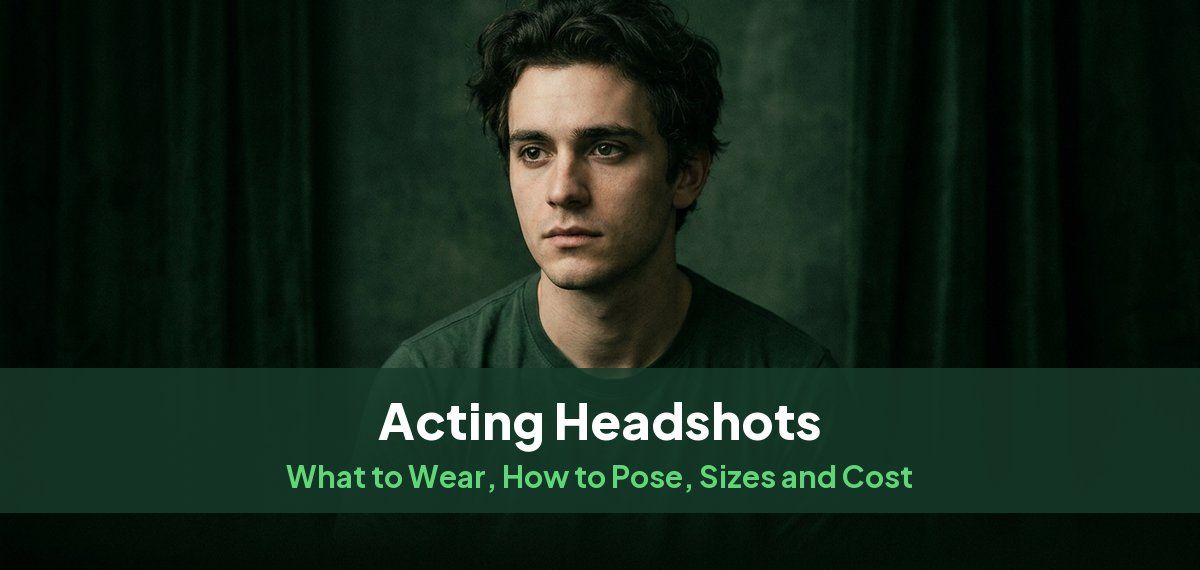
An acting headshot is a close portrait of your head and shoulders that shows casting directors what you look like on a normal day. It should look like you walking into the audition room: natural skin, simple clothes in solid colors, a plain background and an expression that suggests the kind of roles you play. In print it is 8 x 10 inches, stapled to the back of your resume. Online, each casting site sets its own pixel size.
Below: how commercial and theatrical headshots differ, what to wear, how to pose, the print and digital sizes, how many you need, and what a shoot costs.
What casting directors look for
Casting teams, agents and producers look at headshots before they decide who to call in. They go through a lot of them quickly, so a headshot has to read clearly in a second or two and match the person who walks in.
Three things matter more than anything else:
- Accuracy. The photo should show how you look now: your hair, your skin, your build. A headshot that flatters you into someone else wastes the casting director's time and yours.
- Your face first. Clothing, background and lighting should all support your face, not compete with it.
- A hint of type. The expression and styling should suggest the roles you are right for.
How acting headshots differ from modeling headshots
| Acting headshot | Modeling headshot | |
|---|---|---|
| Goal | show the real you, so casting can picture you in a role | show a look or an artistic vision |
| Styling | subtle makeup, simple clothes | can be as bold as the concept needs |
| Range shown through | expression | different looks and styling |
| Camera | usually facing the camera, eyes to the lens | free to play with poses and angles |
| Leads to | auditions for film, TV, theater and commercials | ads, editorials, fashion work |
For the modeling side, see our guide to modeling headshots.
Commercial vs theatrical headshots
Most working actors keep at least two looks, because commercial and theatrical casting want different things.
| Commercial | Theatrical (film, TV, theater) | |
|---|---|---|
| Expression | warm, open, an easy smile with energy in the eyes | thoughtful, grounded, subtle intensity, often no smile |
| Clothing | brighter, warm colors, soft textures, friendly necklines | deeper or neutral tones that add contrast |
| Lighting | bright and soft | softer contrast or more shadow, more mood |
| Message | "you'd trust this person in your ad" | "this person can carry a scene" |
Film headshots sit between the two: a neutral palette and an attentive, natural expression that makes you look adaptable to many roles. We go deeper on the split in theatrical vs commercial headshots.
What to wear for acting headshots
Your outfit should feel like you, photograph well and leave your face as the focus. Nothing needs to be formal.
- Fit first. Clothes that fit your body well matter more than the brand or the style. Try everything on before the shoot.
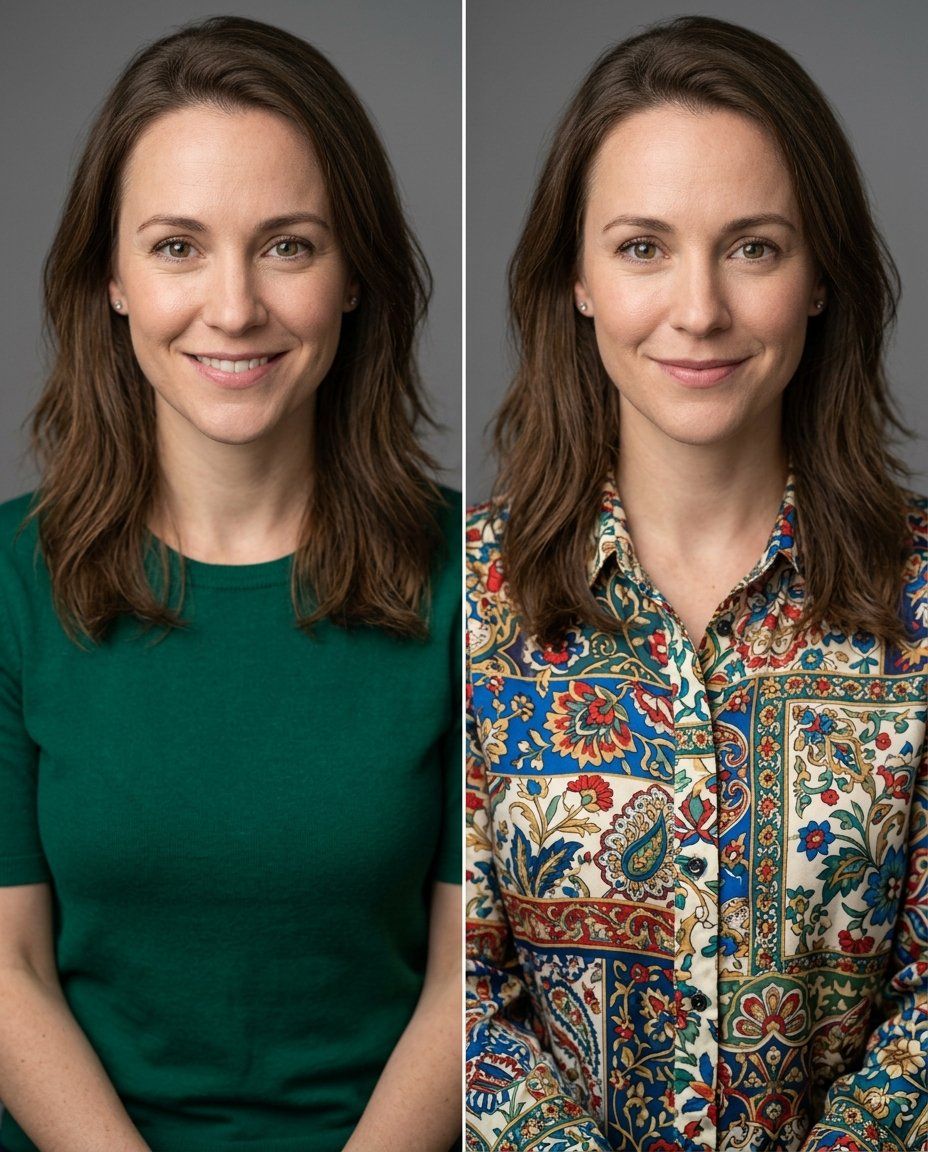
- Solid colors. Choose shades that suit your skin tone. Navy, gray, brown and other neutrals work reliably. Rich jewel tones or soft pastels add color without pulling focus. Pure black or white can look flat on some people, so test them first.
- Skip patterns and logos. Neon colors, loud prints, stripes, graphic tees, logos and big accessories all draw the eye away from your face.
- Layers for depth. A denim jacket, a casual blazer or a cardigan over a plain top adds dimension, as long as it does not overpower the shot.
- Minimal jewelry. Small studs or a fine chain at most.
- Ironed and clean. Wrinkles show, especially at the collar.
Outfits that suggest a type
| Role type | What to wear |
|---|---|
| Commercial, friendly | a neutral crew-neck top, soft knits in warm or bright colors |
| Authority (doctor, lawyer, cop, boss) | a navy T-shirt or button-down, a structured jacket |
| Approachable, everyday | soft knit tops in muted tones |
| Dramatic, sophisticated | a flattering V-neck in a deeper tone |
Outfit tips for women
Pick tops or dresses in solid colors with a flattering neckline. V-necks, scoop necks and round necks all work, so wear the one you are most comfortable in. Skip bulky, frilly or plunging necklines, which pull attention from your face. A fitted slate-blue or gray top gives a grounded commercial feel; jewel tones or earthy shades suit film and theater. Keep makeup and hair natural.
Outfit tips for men
Fitted button-downs and lightweight sweaters keep the frame clean. A denim jacket or casual blazer adds a layer without taking over. Avoid busy patterns and anything that feels like a costume. If something feels forced, it will look forced.
Colors for your skin tone
Colors that suit your undertone photograph more naturally. Warm undertones pair well with earthy and saturated colors. Cool undertones look good in soft neutrals and lighter pastels. Try a few options in front of a mirror, or take test selfies in daylight, before the session.
How to pose for acting headshots
Posing for a headshot is acting in a smaller space. Subtle changes read best, and your eyes should carry most of the feeling.
- Face the camera, eyes to the lens. A slight three-quarter turn of the shoulders, with your face toward the camera, looks more natural than standing square.
- Release your jaw. Tension in the jaw shows in the whole face. Part your lips very slightly between shots.
- Drop your shoulders and lengthen your neck. Nerves make shoulders creep up.
- Breathe slowly between frames.
- Smile with your eyes. A real smile reaches your eyes. Thinking of a specific pleasant memory works better than "say cheese".
- Try small variations. Thoughtful, warm, curious, serious. Small shifts give casting a sense of range without overacting.
- Ask for a few camera angles. The same pose shot from eye level, slightly above and slightly below can look very different. A slightly raised camera helps if you are self-conscious about your chin.
- Keep what makes you, you. Freckles, a gap in your teeth, curly hair or a birthmark are part of how you will be cast. Do not hide them.
Expressions by role type
| Role type | Expression |
|---|---|
| Commercial | a warm, approachable smile |
| Dramatic theater | thoughtful intensity or grounded confidence |
| Film | neutral attentiveness or a soft, subtle smile |
Practice in a mirror or with selfies a few days before. Expressions that feel natural in the room are the ones you rehearsed. For more poses, see headshot poses that work.
Backgrounds and lighting
A plain wall or a soft outdoor background works as well as a studio backdrop, as long as the light is flattering.
- Neutral solid backgrounds (light gray, charcoal, soft beige, light blue) keep attention on you and suit serious roles.
- Soft textures or gradients add interest, but keep them quiet.
- Outdoor shots suit commercial and comedic roles. A clean leafy background or a blurred city street can hint at a type, as long as the setting stays out of focus.
- Light should be soft and even on the face. Daylight with a diffuser, studio strobes and LEDs all work; most photographers mix them.
Shoot in color. Black and white is only worth it when a casting call or an agency asks for it.
How to prepare for the shoot
- Decide which roles you are going out for. If the shoot is for a specific project, read what you can about the character and dress toward it.
- Book grooming early. A haircut, beard trim or brow shaping should happen 5 to 7 days before, so it looks grown in.
- Keep skin prep simple. A light moisturizer, plenty of water and no new products in the days before.
- Test your makeup. Keep it soft, matte and natural. If a makeup artist is booked, ask for a low-key look.
- Try on every outfit and bring two or three options per look.
- Rehearse expressions in a mirror.
- Sleep and eat. Tiredness shows in the eyes more than anywhere else.
Looking at headshots of actors you admire helps you see how presence comes through in a still image. Use them for ideas, not as something to copy.
Headshot sizes for print and casting sites
The standard print size for an acting headshot is 8 x 10 inches, with your resume cut to the same size and attached to the back. University career centers give the same rule; Loyola University New Orleans' actor resume guide, for one, says headshots are 8 x 10 photographs with the resume on the back. For a crisp print at 300 dpi, that is 2400 x 3000 pixels.
Online, each casting platform sets its own size:
| Where | Size | Other limits |
|---|---|---|
| 8 x 10 in (2400 x 3000 px at 300 dpi) | resume cut to fit on the back | |
| Actors Access | optimal 500 x 700 px | |
| Casting Networks | minimum 360 x 360 px | JPG, PNG or GIF; up to 30 MB |
| Spotlight (UK) | minimum 500 x 500 px | file between 1 MB and 40 MB |
Keep a full-resolution JPEG master and export smaller copies from it, rather than resizing a resized file. Avoid heavy compression and filters, and make sure your eyes stay sharp after any crop. Every size, ratio and pixel conversion is in our guide to headshot dimensions.
Attaching a headshot to your resume
Check the submission instructions first: a casting office or agency may ask for a specific format. If there are none:
- Staple the headshot and resume back to back, with the resume trimmed to 8 x 10. Staples at the corners hold; paper clips fall off.
- Print your name on the front of the headshot, at the bottom.
- For digital submissions, put the headshot on the page before the resume, or upload it in the platform's photo field, and name the file with your name.
How many headshots you need
- One strong primary headshot for most submissions.
- A second look so you can cover both commercial and theatrical casting.
- Three or more once agents or casting offices start asking for variety.
From a photographer, aim for at least five finished images across two or more looks (different tops, hair and expressions), not five angles of the same shot.
For in-person auditions, carry three to five prints that suit the role, and a few more for networking events. A small stack of strong prints is better than a pile of weak ones. Keep the digital files on your phone too.
How much acting headshots cost
Prices vary widely by city and photographer. What moves the price:
- the photographer's experience and how much of their work is actors
- the number of looks and outfit changes
- the number of retouched images included
- studio, outdoor location or both
- hair and makeup
- how much retouching you want
For current price ranges by tier and city, see how much a professional headshot costs.
When comparing photographers, look past price:
- Portfolio. Look for work with actors specifically, with natural expressions and consistent lighting.
- Recommendations. Ask acting teachers, classmates and local acting schools.
- Consultation. A short call shows whether they direct expression and whether you feel at ease with them.
- What is included. Number of looks, number of retouched images, and how long you get to choose.
AI headshots are an option for keeping a digital profile current between shoots. Headshots by Magic Studio turns about ten of your own photos into 50 headshots across 5 looks, ready in 15 minutes. You see them before paying, and packs start at $49: a starter pack of 3, all 50 for $59, or all 50 in print-ready high resolution for $69. For an agent or a major casting submission, a photographer who works with actors is still the safer choice.
Retouching: how much is too much
Retouching should remove what is temporary (a blemish, stray hairs, uneven lighting) and leave what is permanent (freckles, scars, moles, lines). If you would not look like the photo when you walk into the room, it has gone too far. Most photographers include retouching in the package, so agree on the level before the shoot. Avoid editing the files yourself unless you know the software well; heavy edits show badly in print.
Common mistakes
- Not talking to the photographer about the roles and looks you want before the day.
- Overdoing it: heavy makeup, statement jewelry, busy clothes or heavy retouching.
- Not rehearsing expressions, which shows as stiffness.
- Submitting an old headshot that no longer looks like you.
- Micromanaging the shoot. Say what you need, then let the photographer work.
When to update your acting headshots
The usual rule among actor headshot photographers is every two to three years (one Seattle actor photographer calls it the industry standard). Update sooner if:
- your hair changes noticeably (a new cut or color, growing out or cutting off a beard)
- your weight or build changes
- you start or stop wearing glasses
- you are moving into a different type of role or genre
Using your headshots
- Upload your best shots to every casting platform you use, at each platform's size.
- Bring prints to auditions, classes and networking events.
- Use the same primary headshot on your actor website and social profiles so people recognize you.
- If a submission allows more than one photo, use your commercial and theatrical looks.
Common questions
What should I wear for acting headshots?
Wear simple, well-fitting clothes in solid colors that suit your skin tone, such as navy, gray, brown or a jewel tone. Avoid logos, loud patterns, stripes, neon colors and big jewelry. Choose brighter, warmer colors for commercial looks and deeper or neutral tones for theatrical ones.
What is the difference between commercial and theatrical headshots?
Commercial headshots are bright and warm, with an open, friendly smile, and are used for ads. Theatrical headshots, for film, TV and theater, are more subdued, with a thoughtful or intense expression and deeper colors. Many actors keep one of each.
What size is an acting headshot?
The standard print size is 8 x 10 inches, with the resume trimmed to fit on the back; that is 2400 x 3000 pixels at 300 dpi. Online sizes depend on the platform: Actors Access recommends 500 x 700 pixels, Casting Networks needs at least 360 x 360 pixels, and Spotlight needs at least 500 x 500 pixels.
How should I pose for an acting headshot?
Turn your shoulders slightly with your face toward the camera, look into the lens, relax your jaw, lower your shoulders and breathe between shots. Keep expressions subtle and let your eyes do the work. A slightly raised camera angle helps if you are conscious of your chin.
How often should I update my acting headshots?
Every two to three years is the common guidance, and sooner if your appearance changes noticeably, for example a new haircut, a change in weight, starting to wear glasses, or a move into a new type of role.
Can I use AI headshots for acting?
AI headshots can keep a digital profile current between shoots, as long as the results look exactly like you, with natural skin texture and no changes to your features. For agent submissions and major casting calls, a photographer who works with actors remains the safer choice.